
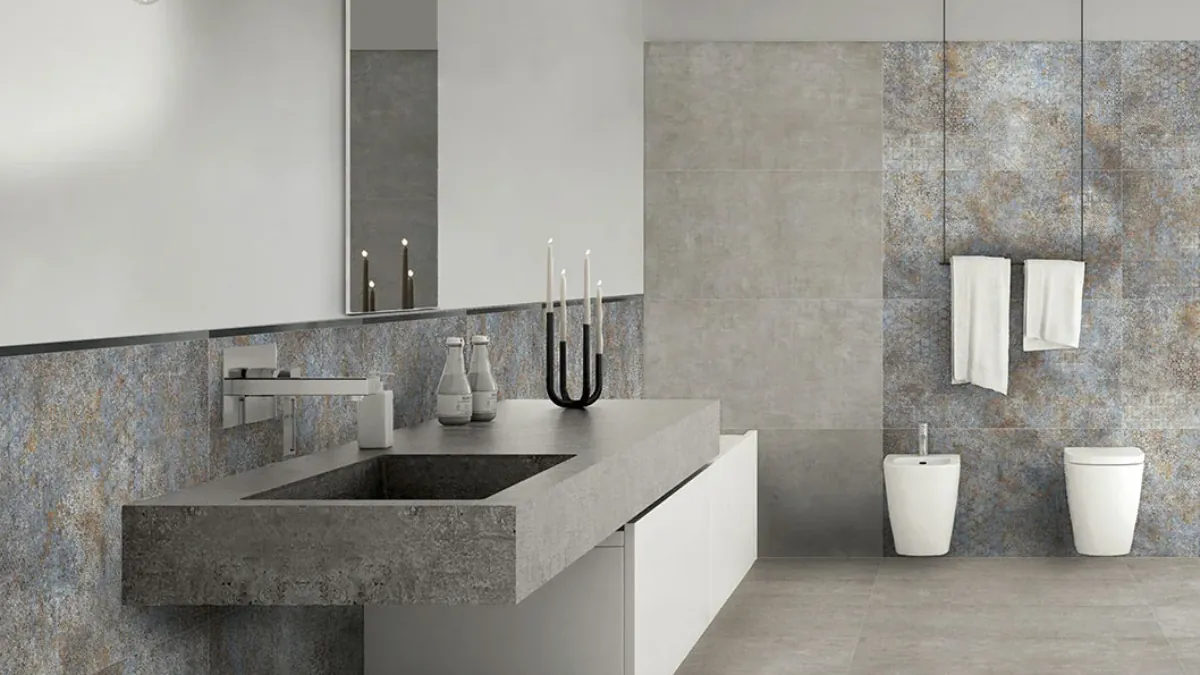
The secret to a luxurious small bathroom is doing fewer things beautifully, not fitting more in. Large-format tiles with thin, tonal grout running from wall to floor, a wall-hung WC and floating vanity to keep the floor visible, concealed layered lighting, a single large mirror, and one considered feature — a book-matched panel or a single striking material — do more for a compact room than any amount of clever storage or busy pattern. Material restraint, not square footage, is what makes a small bathroom read as high-end.
Small bathrooms are often treated as a problem to be solved with clever storage and space-saving fittings. That’s the wrong starting point. The bathrooms that genuinely feel luxurious despite their size are the ones where every material and fitting decision has been pared back and considered — restraint reads as expensive, clutter reads as cheap, regardless of the actual floor area. Our design team at Design Di Lusso sets out the moves that consistently make a small bathroom feel like a high-end retreat.
Why large-format tiles make a small bathroom look bigger
Large-format tiles minimise grout lines, and grout lines are what fragment a small room visually. Every joint is a place where the eye registers a break, so a floor or wall covered in many small tiles reads as busy and compartmentalised — emphasising exactly how little space there is. Swap to 600×600mm or 600×1200mm tiles with thin, tonal grout, and those breaks largely disappear: the surface reads as one continuous plane, the eye travels further before hitting an interruption, and the room feels calmer and more spacious than its actual dimensions.
How wall-to-floor tone continuity creates luxury
Running the same tile, or at least the same tone, from the floor up onto the walls removes another visual break — the line where floor meets wall, which otherwise reads as a boundary that contains the eye within a smaller area. A continuous surface with no colour or material change stretches the sense of space and gives a small bathroom the calm, enveloping feel associated with high-end spa design.
Should fittings be wall-hung?
Yes, almost always. This comes down to a simple principle: the more visible floor a room has, the bigger it feels. A wall-hung WC and a floating vanity both lift the eye-line down to an uninterrupted floor plane beneath them, rather than blocking it with a pedestal, cistern unit or floor-standing cabinet. The visual weight is removed from floor level, the actual floor tile is allowed to read as a continuous surface, and the room feels more open — a subtle but consistently effective luxury cue in compact bathrooms.
The 10 designer moves for a luxurious small bathroom
- Large-format tiles with thin, tonal grout on floor and walls, minimising visual breaks.
- Wall-to-floor tone continuity — one tile or tone running unbroken through the whole room.
- Wall-hung WC and floating vanity to keep the floor visible and uncluttered.
- One considered feature — a book-matched panel, a striking stone-effect wall, a single bold material moment.
- Concealed, layered lighting rather than a single central ceiling light.
- A large mirror, ideally full-width above the vanity, to bounce light and visually double the sense of space.
- Warm, layered neutrals instead of a flat, cold white scheme.
- Fewer, better materials, repeated confidently rather than many materials used sparingly.
- A walk-in shower with a minimal-frame glass screen, avoiding a bulky enclosure that visually divides the room.
- Considered brassware in a single finish, chosen deliberately rather than picked piecemeal.
How concealed lighting makes a small bathroom feel expensive
A single central ceiling light is the fastest way to make any bathroom, small or large, feel flat and functional rather than considered. Layered, concealed lighting does far more work:
- Wall-washing — light grazed down a feature wall or tiled surface adds texture and depth rather than flattening it under one bright source.
- Backlit mirrors — a soft halo of light around the mirror adds a genuinely hotel-like quality and doubles as flattering, practical task lighting.
- Plinth lighting beneath a floating vanity — reinforces the sense of a “floating,” uncluttered floor and adds a subtle glow at low level.
- Warm colour temperature throughout — cool white lighting reads as clinical, while a warmer tone feels considered and inviting.
Should a small bathroom have a feature wall?
Yes — one. A single, considered feature — a book-matched marble-effect panel behind the bath or in the shower, for instance — gives a small bathroom a clear focal point and a genuine sense of occasion, without overwhelming the space. The key word is “one”: a small room can carry exactly one statement moment well, but loses its sense of calm and luxury quickly if pattern or contrast is introduced on every surface.
Small bathroom mistake vs luxury fix
| Common mistake | Luxury fix |
|---|---|
| Tiny mosaic tiles everywhere | Large-format tiles with thin, tonal grout |
| Floor-standing WC and vanity units | Wall-hung WC and floating vanity |
| Flat, cold white scheme throughout | Warm, layered neutrals |
| Multiple contrasting materials | Fewer, better materials repeated confidently |
| Pattern or contrast on every surface | One considered feature, calm surroundings |
| Single central ceiling light | Concealed, layered lighting |
| Small, framed mirror | One large, ideally backlit, mirror |
| Bulky framed shower enclosure | Walk-in shower, minimal-frame screen |
| Mismatched taps, handles and accessories | Considered brassware in one consistent finish |
| Storage crammed in wherever it fits | Fitted, concealed storage integrated into the vanity |
Where people go wrong
Three mistakes come up again and again in small bathrooms that don’t quite achieve the luxury feel they’re aiming for:
- Tiny mosaics everywhere. An instinct to use small tiles “because the room is small” backfires — it adds grout lines and visual clutter exactly where a calmer, larger surface would help.
- Too many materials. Mixing several stone-effect tiles, several metals, and several accent colours in one small room reads as busy and indecisive rather than curated.
- Cold, flat white. A stark white scheme with no warmth or texture can feel clinical rather than luxurious — warmth and material depth matter more than brightness alone.
How to choose materials
The guiding principle is simple: fewer, better, repeated. Choose one exceptional tile, one brassware finish, one stone-effect surface, and use them confidently and consistently throughout the room, rather than introducing a different material for every element. A small bathroom built around two or three well-chosen materials, repeated with intent, will always read as more considered — and more expensive — than one assembled from many individually nice but uncoordinated choices.
Frequently asked questions
What tile size makes a small bathroom look luxurious?
Large-format tiles — typically 600×600mm or 600×1200mm — with thin, tonal grout lines, since fewer visible joints create a calmer, more spacious-feeling surface.
Should a small bathroom have a bath or just a shower?
This depends on the household’s needs rather than luxury alone, but where space is tight, a well-detailed walk-in shower with a minimal-frame screen often reads as more spacious and high-end than a cramped bath and separate shower combination.
Does a wall-hung toilet really make a difference in a small bathroom?
Yes — by lifting visual weight off the floor and keeping the floor plane visible and continuous, a wall-hung WC and floating vanity make a genuinely noticeable difference to how spacious a small bathroom feels.
What colours make a small bathroom look expensive?
Warm, layered neutrals generally read as more luxurious than a stark, flat white — depth and warmth in the tone matter more than simply choosing the lightest possible colour.
Is a big mirror better than a small one in a compact bathroom?
Yes — a large mirror, ideally full-width above the vanity, bounces significantly more light around the room and visually doubles the sense of space compared with a smaller, framed mirror.
Can a small bathroom have a feature wall?
Yes, and it’s one of the most effective ways to add a sense of luxury — provided it’s kept to a single considered feature rather than pattern used throughout the room.
How much storage should a small luxury bathroom have?
Enough to keep surfaces clear, but concealed within the vanity or fitted joinery rather than added as visible extra units — clutter undermines the sense of calm that makes a small bathroom feel high-end.
What lighting is best for a small bathroom?
Layered, concealed lighting — wall-washing, a backlit mirror and plinth lighting under a floating vanity — in a warm colour temperature, rather than relying on a single central ceiling light.
Do luxury small bathrooms need underfloor heating?
It’s not essential to the look, but it removes the need for a radiator, freeing up wall space and contributing to the sense of an uncluttered, considered room.
The bottom line
A luxurious small bathroom is built on restraint: large-format tiles with thin grout, wall-to-floor tone continuity, wall-hung fittings, layered concealed lighting, one large mirror and a single considered feature. Resist the urge to fill a small room with more — fewer, better choices, repeated with confidence, are what make a compact bathroom feel genuinely high-end.