
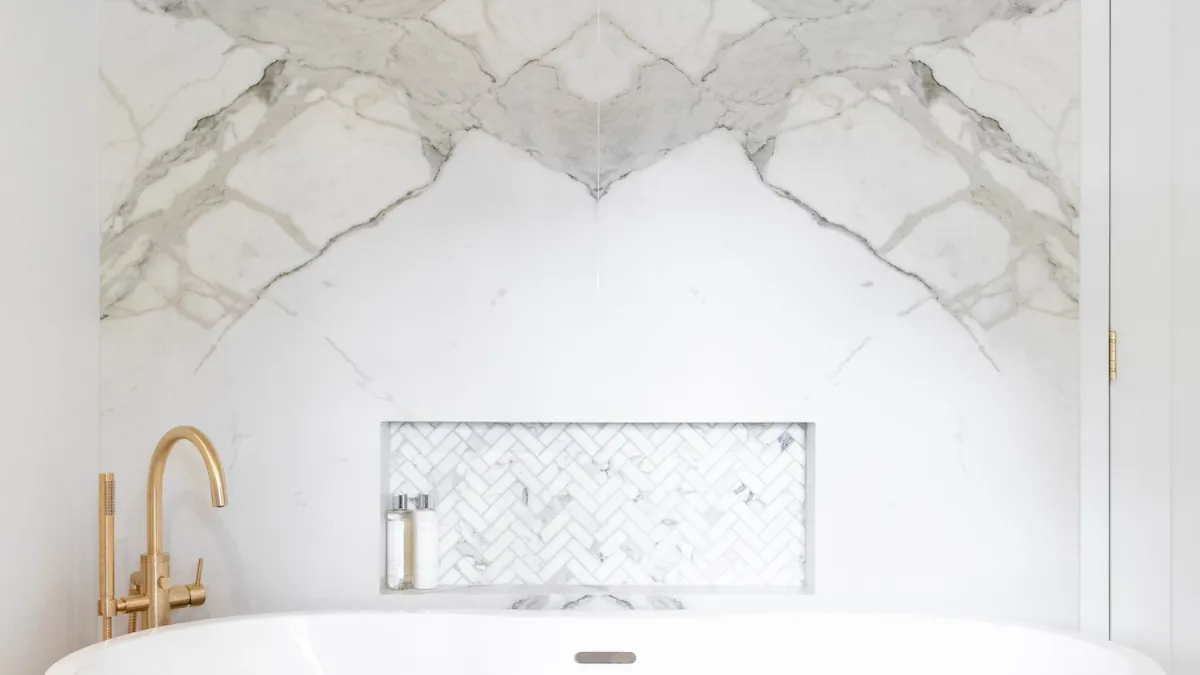
Book-matched tiles are consecutive tiles or slabs cut from the same block of marble and laid side by side as mirror images, so the natural veining opens up symmetrically across the join — like the pages of an open book, which is where the name comes from. The effect, sometimes called the “butterfly”, creates a dramatic, one-off pattern that reads as a single continuous piece of stone. Designers love it because it delivers bespoke, slab-like luxury, and it’s best used on one uninterrupted feature surface — a bath wall, a shower end panel, a vanity splashback or a single feature wall — rather than scattered across a busy, multi-surface room. Large-format porcelain has made the look genuinely attainable, where it was previously the preserve of six-figure natural stone slab projects.
Book-matching is one of those design details that instantly signals a considered, high-end space — and once you know what to look for, you’ll spot it everywhere in luxury hotel bathrooms and flagship showrooms. It’s also more accessible than most people realise. Our design team at Design Di Lusso explains exactly what book-matching is, why it has become one of the most requested looks in premium bathroom design, and how to use it well.
What does book-matched actually mean?
Book-matching is a specific method of laying tiles or slabs so that the natural pattern — almost always marble veining — mirrors itself across the join between two pieces, exactly as if you opened a book flat and looked at the two facing pages. The veining on one tile flows into its neighbour as a reflection rather than a repeat, creating a symmetrical, often dramatic “butterfly” shape at the centre of the composition.
It’s worth distinguishing book-matching from its close cousin, vein-matching: vein-matching lines up the veining so it continues in the same direction across several tiles, like a single pattern flowing across a wall, while book-matching specifically mirrors it, creating that symmetrical reflection. Both rely on using consecutive tiles cut from the same block or the same production batch, so the pattern genuinely lines up rather than being an approximate match.
Why designers love it
- It’s bespoke. No two book-matched installations are identical, since natural veining is unique to each block — the result is genuinely one-off, in a way a standard tile layout never can be.
- It creates instant drama and a focal point. A book-matched panel draws the eye immediately, giving a room a clear, considered centrepiece rather than a flat, uniform surface.
- It delivers seamless, slab-like luxury. Done well, a book-matched wall reads as a single, continuous piece of stone rather than an assembly of individual tiles — the hallmark of a high-end natural stone installation.
- It elevates a room through restraint. A single book-matched feature, used sparingly against calmer surrounding surfaces, often has more impact than pattern used throughout — it lets the material do the talking.
How is book-matching created?
- Source matched material. Consecutive slabs or tiles are selected from the same block or production run, ensuring the veining pattern is genuinely continuous from one piece to the next.
- Set out the composition. Before anything is fixed, the pieces are arranged and mirrored to plan exactly how the veining will meet and reflect at the centre join.
- Dry-lay and check. The full panel is typically dry-laid first, so the pattern match can be checked and adjusted before adhesive is applied — there’s no room for error once tiles are fixed.
- Rectified edges and thin grout. Precision-cut rectified edges allow the tiles to be laid with the thinnest possible grout line, so the veining appears to flow across the join with minimal interruption.
- Skilled installation. Because alignment has to be exact for the mirroring effect to work, book-matched installations require an experienced tiler used to working with pattern-matched material.
Where to use book-matched tiles
- Bath wall. The wall behind a freestanding bath is one of the most popular locations — an uninterrupted vertical surface that becomes the room’s natural focal point.
- Shower end panel. A single feature panel at the end of a walk-in shower creates drama without needing to book-match an entire wet room.
- Vanity splashback. A compact, contained area that shows off the mirrored veining up close, often paired with a matching or complementary vanity top.
- Statement feature wall. Outside the bathroom, a book-matched panel can anchor a hallway, a bedroom headboard wall or a powder room.
- Powder room. A small, high-impact space where a single book-matched wall can carry the entire design statement.
Where NOT to use it
- Busy, multi-surface rooms where a book-matched feature would compete with other patterns and materials rather than stand out.
- Walls broken up by fixtures, niches or changes in plane — the mirroring effect depends on an uninterrupted surface to read properly.
- Floors, generally — book-matching is a vertical, eye-level technique; the effect is far less visible and less practical underfoot.
- Thick, contrasting grout, which breaks the illusion of a continuous surface that book-matching depends on.
- Everywhere at once. Book-matching loses its impact — and its sense of restraint and luxury — if it’s used on every surface in a room rather than as a single, considered feature.
Book-matched porcelain vs natural marble slab
| Factor | Book-matched porcelain | Natural marble slab |
|---|---|---|
| Cost band | Mid to premium | Premium to very high (often six-figure for large projects) |
| Material needed | Large-format tiles | Full natural stone slabs |
| Weight | Lighter, easier to handle and fix | Very heavy, needs reinforced support |
| Sealing / maintenance | None needed | Ongoing sealing required |
| Consistency / risk | Reliable, factory-controlled printing | Natural variation, quarry-dependent availability |
| Water suitability | Fully waterproof | Porous, needs careful sealing in wet areas |
| Where used | Feature walls, splashbacks, bath surrounds | Feature walls, worktops, high-end slab projects |
| Uniqueness | High-fidelity printed reproduction | Truly one-of-a-kind natural material |
How large-format porcelain makes it attainable
Book-matching used to mean specifying genuine natural marble slabs — heavy, expensive to source, transport and install, and firmly the preserve of the very top end of the market, often running into six figures for a full project. The rise of high-definition printed large-format porcelain changed that. Today’s premium marble-effect porcelain reproduces veining with enough fidelity and consistency that book-matched panels can be created reliably, in a lighter, more affordable, waterproof material — bringing a look that was once genuinely rare into reach for a considered bathroom renovation.
Which marble looks work best?
| Marble look | Character |
|---|---|
| Calacatta | Bold, dramatic gold-grey veining on a bright white ground |
| Statuario | Soft grey veining, classic and refined |
| Nero Marquina | Striking white veining on a deep black ground |
| Grey / Pietra Grey | Subtle, contemporary tonal veining |
| Carrara | Delicate, fine grey veining, timeless and versatile |
How to style a room around a book-matched feature
The most successful schemes treat the book-matched panel as the room’s single statement and keep everything else deliberately calm around it: a plain, tonal large-format tile on the remaining walls and floor, understated brassware in one consistent finish, and concealed or minimal lighting that washes the feature wall rather than competing with it. The panel does the work — the rest of the room simply gives it space.
Frequently asked questions
What does book-matched tile mean?
It means consecutive tiles or slabs, cut from the same block, laid as mirror images so the veining reflects symmetrically across the join, creating a butterfly-like pattern.
Is book-matching only possible with natural marble?
No — while it originated with natural marble slabs, high-definition large-format porcelain now reproduces the effect reliably and more affordably, without the weight or sealing needs of real stone.
Where should book-matched tiles be used?
On a single, uninterrupted feature surface — a bath wall, shower end panel, vanity splashback or feature wall — rather than across a busy room with multiple surfaces and fixtures.
Is book-matched porcelain more expensive than standard tile?
Yes, it typically costs more than a standard tile layout, reflecting the careful sourcing, dry-laying and skilled installation required, though it remains considerably more affordable than a natural marble slab equivalent.
What’s the difference between book-matched and vein-matched tiles?
Book-matching mirrors the veining across the join, like an open book; vein-matching lines the veining up to flow continuously in the same direction across multiple tiles.
Can book-matched tiles be used on a floor?
It’s technically possible but rarely recommended — book-matching is primarily a vertical, eye-level effect, and its impact is far less visible underfoot on a floor.
Does book-matching require special installation?
Yes — it requires careful dry-laying to check the pattern match before fixing, rectified edges for the thinnest grout lines, and an experienced tiler familiar with pattern-matched material.
How many tiles are needed for a book-matched panel?
It depends on the size of the surface, but the tiles must be consecutive pieces from the same block or production batch — this needs to be planned and sourced together, not assembled from separately purchased tiles.
Does book-matched porcelain need sealing?
No — unlike natural marble, book-matched porcelain is fully waterproof and needs no ongoing sealing, making it a lower-maintenance route to the same visual effect.
What room works best for a book-matched feature?
Bathrooms are the most popular setting — particularly behind a freestanding bath, on a shower end panel, or as a vanity splashback — though powder rooms and feature walls elsewhere in the home also suit it well.
Can you book-match tiles in a small bathroom?
Yes — in fact a single book-matched panel can work particularly well in a small bathroom or powder room, giving the space a clear, high-impact focal point without needing pattern anywhere else.
See book-matched panels in person
Book-matched veining, and the way it flows across a join, is genuinely difficult to judge from a photograph — the scale and the symmetry only fully reveal themselves standing in front of the finished panel. Visit our Watford showroom to see book-matched porcelain feature walls at full size and talk through where the technique could work in your own project.