
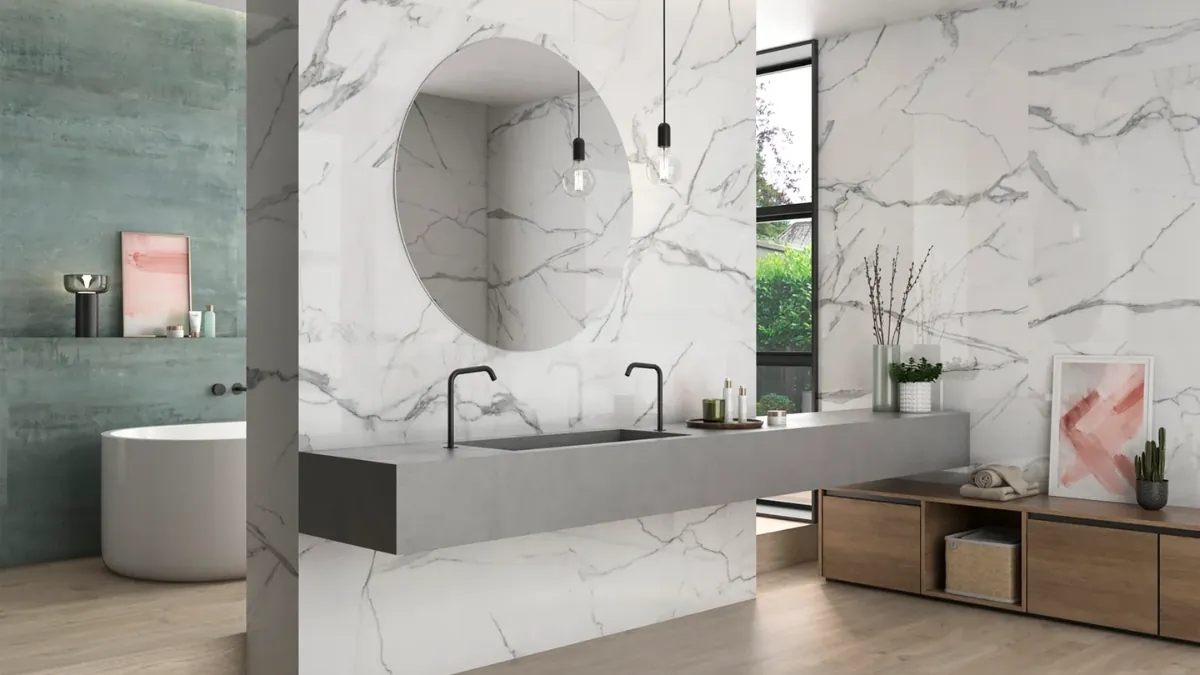
Matt or honed tiles are the right choice for floors, wet areas and family bathrooms, thanks to their higher slip resistance (typically R10-R11), while polished tiles suit walls and feature areas, where their light-reflecting shine adds a sense of luxury but becomes genuinely slippery when wet underfoot (around R9). Honed and lappato finishes sit in between, offering a soft, low-sheen middle ground. The simplest rule our designers use: matt where you walk, polished where you look.
It’s one of the first decisions in any tile specification, and one that’s easy to get backwards: choosing a finish for how it looks in the showroom rather than how it performs in daily use. Matt and polished aren’t just a style preference — they behave very differently underfoot, in terms of maintenance, and in how they handle light in a room. Our design team at Design Di Lusso breaks down the real difference and where each finish genuinely belongs.
What is the actual difference?
Matt and polished are surface finishes, not different tile bodies — the same porcelain or ceramic tile can typically be produced in either finish, or several finishes in between. The difference lies entirely in how the surface is treated after firing: a polished finish is mechanically buffed to a high shine, while a matt finish is left with a flat, non-reflective surface, sometimes lightly textured. This matters because it means finish and material are independent choices — you’re not sacrificing the marble-effect pattern you love by choosing it in matt rather than polished.
Are polished tiles slippery?
Yes — this is the single most important practical fact in the matt-versus-polished decision. Polished tiles typically carry a slip rating of around R9, the lowest common rating, meaning they offer noticeably less grip than a matt or honed equivalent, particularly when wet. Matt and honed tiles typically rate R10-R11, giving significantly more secure footing. In any area where water is likely to be on the floor — a bathroom, a wet room, a kitchen — that difference in grip is a genuine safety consideration, not just a technical spec.
Matt vs honed vs polished vs lappato
| Finish | Look | Slip / grip | Best use | Maintenance | Light reflection |
|---|---|---|---|---|---|
| Matt | Flat, non-reflective, contemporary | High (R10-R11) | Floors, wet areas, family bathrooms | Low, forgiving of marks | Minimal |
| Honed | Soft, low sheen, smooth | Good (R10) | Floors and walls, versatile middle ground | Low to moderate | Low |
| Lappato | Semi-polished, subtle shine | Moderate | Walls, low-traffic floors | Moderate | Moderate |
| Polished | High shine, reflective, glamorous | Lower (~R9) | Walls, feature areas, dry rooms | Higher, shows marks and smears | High |
Where matt tiles belong
- Floors, where secure footing matters every single day, wet or dry.
- Wet-room floors, where standing water makes grip a genuine safety issue.
- Family bathrooms, where children, older family members and general daily use all favour a more forgiving, higher-grip surface.
- Contemporary schemes, where a flat, non-reflective surface suits a pared-back, understated aesthetic.
Where polished tiles belong
- Walls, where slip resistance is irrelevant and the reflective shine can be fully appreciated.
- Feature areas such as a book-matched panel or splashback, where polished porcelain’s light-catching quality adds genuine drama.
- Dry rooms, such as a powder room or a bedroom-adjacent ensuite with minimal splash risk.
- Small or dark rooms, where the extra light bounced around by a polished surface can make a real difference to how bright the space feels.
How to mix matt and polished in one room
One of the most effective techniques our designers use is specifying the same tile in two finishes within a single room — a polished finish on the walls, where it can shine safely, and a matt or honed finish on the floor, where grip matters. Because many premium ranges offer both finishes from the same design, this gives a coordinated, considered look without compromising on safety underfoot. It’s a simple way to get the glamour of polished tile without the risk of a slippery floor.
Which finish is easiest to clean?
Matt and honed finishes are generally more forgiving day to day. Polished tiles show water marks, smears and fingerprints far more readily, since the reflective surface highlights every mark under changing light — meaning a polished wall or splashback often needs more frequent wiping to stay looking pristine. Matt surfaces, by contrast, diffuse light rather than reflect it, so minor marks and everyday use are considerably less visible.
Where each finish is not right
- Polished tiles on any wet-area floor — showers, wet rooms, family bathroom floors — where the lower slip rating becomes a genuine hazard.
- Matt tiles where you want maximum shine and light-bounce — a matt finish simply won’t deliver the glamorous, reflective look polished offers.
- Polished tiles in a household with young children or elderly residents, on any floor area, given the reduced grip.
- Matt finishes in a very small, naturally dark room where every bit of reflected light helps — polished or lappato may serve the space better here.
- High-traffic polished floors generally, since they show wear, scuffing and cleaning marks more visibly over time than matt equivalents.
How finish affects room feel
Beyond the practical considerations, matt and polished create genuinely different moods. Matt tends to read as calm, contemporary and understated — light is absorbed rather than bounced, giving a softer, more grounded feel. Polished reads as glamorous and light-filled, with reflections adding a sense of scale and luxury, particularly effective in a feature wall or a compact space that benefits from extra brightness. Neither is objectively better — the right choice depends on the mood you want and, critically, where in the room the tile will be used.
Frequently asked questions
Are matt tiles better than polished for bathroom floors?
Yes, for slip resistance — matt and honed tiles typically offer a significantly higher grip rating (R10-R11) than polished tiles (around R9), making them the safer choice for any bathroom floor.
Can you use polished tiles in a bathroom at all?
Yes, on walls and dry, low-splash areas — polished tiles work well as a feature or on vertical surfaces, but should generally be avoided on wet-area floors due to reduced grip.
What is the difference between honed and matt tiles?
Honed tiles have a soft, smooth, low-sheen surface, sitting between matt and polished in both look and slip resistance, while matt tiles are fully flat and non-reflective with the highest grip.
Do polished tiles scratch more easily than matt tiles?
Polished surfaces can show fine scratches and wear more visibly over time because the reflective finish highlights imperfections, whereas a matt surface tends to disguise minor marks more effectively.
Can matt and polished tiles be used together in the same room?
Yes, and it’s a popular designer technique — using the same tile design in a polished finish on walls and a matt or honed finish on the floor gives a coordinated look without compromising safety underfoot.
What is a lappato finish?
Lappato is a semi-polished finish that sits between matt and full polish, giving a subtle sheen with moderate slip resistance — a versatile middle-ground choice for walls and lower-traffic floors.
Which finish makes a small bathroom feel brighter?
Polished or lappato finishes reflect more available light around the room, which can help a small or naturally dark bathroom feel brighter, though matt remains the safer choice for the floor itself.
Do polished floor tiles need special maintenance?
They generally need more frequent cleaning to stay looking their best, since the reflective surface shows water marks, smears and general wear more readily than a matt or honed equivalent.
The designer’s verdict
Matt where you walk, polished where you look. Specify matt or honed tiles for any floor, especially in wet areas and family bathrooms, and save polished finishes for walls and feature areas where their light-catching shine can be fully enjoyed without any safety trade-off. Come and see both finishes side by side in our showroom — the difference in look and feel underfoot is best judged in person.