
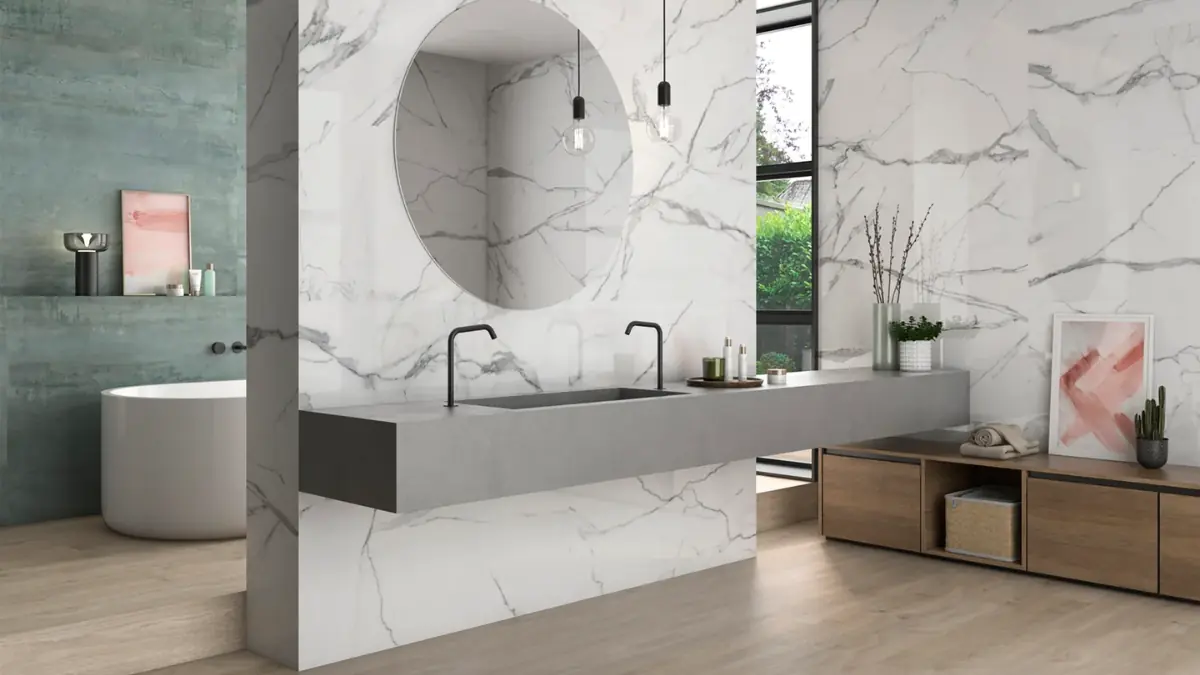
For most luxury bathrooms, marble-effect porcelain is the better choice because it delivers the look of natural marble with far better water resistance, durability and value, while natural marble remains unmatched for genuine stone depth in dry, low-use feature areas. Porcelain absorbs under 0.5% water, never needs sealing, and won’t etch when it meets acids, where real marble is porous, stains and etches without ongoing care. Modern rectified, large-format marble-effect porcelain now reproduces marble’s veining so convincingly that most people can’t tell the difference on a finished wall. So the honest verdict is this: specify marble-effect porcelain for the working surfaces of a bathroom (floors, showers, wet walls), and reserve real marble for a dry, decorative feature where its natural translucency and slab character genuinely earn their keep.
That is the direct answer. But “porcelain or marble for your bathroom?” deserves a proper conversation, because both are genuinely premium materials, and the right choice depends on which qualities you weigh most heavily: authenticity, practicality, cost over a lifetime, or sheer drama. In this guide, our design team at Design Di Lusso compares the two across every dimension luxury buyers actually care about, and tells you, honestly, exactly where each one wins.
First, what are we actually comparing?
It’s worth being precise, because “marble” gets used loosely. There are two distinct products here, and confusing them leads to expensive decisions.
Natural marble is real metamorphic stone, formed from limestone under heat and pressure. It is composed largely of calcium carbonate, which is what gives it its beautiful translucent depth, and also its chemical vulnerability. Marble is quarried, cut into slabs or tiles, polished or honed, and then must be sealed to survive in a wet environment. Carrara, Calacatta, Statuario and Emperador are all natural marbles.
Marble-effect porcelain is a high-fired ceramic tile, made from refined clays pressed and fired at over 1,200°C, then surface-printed with high-resolution digital imaging to reproduce marble’s veining, movement and colour. The best ranges use multiple veining passes and through-body or deep-glaze technology so the pattern has real depth rather than looking flat or repetitive. On a rectified, large-format tile, the result is a near-seamless marble look with none of marble’s chemistry.
So this isn’t “real versus fake.” It’s two premium specifications — one a natural stone, one an engineered surface — each with a genuine place in luxury design. The question is which belongs where.
Does porcelain really look like marble now?
This is the question that has changed most in the last decade, and the honest answer is: yes, convincingly, far more than most people expect.
Early marble-effect tiles were repetitive and obviously printed. Today’s premium porcelain is a different proposition. High-resolution digital printing reproduces fine veining, soft clouding and the subtle colour shifts of real Calacatta or Statuario. Manufacturers now produce dozens of unique faces within a single range, so veins don’t visibly repeat across a wall — the giveaway that used to expose cheaper imitations. On a finished, grouted wall, most people, including many designers, cannot tell a quality marble-effect porcelain from honed marble at normal viewing distance.
Where real marble still has the edge is up close and in the right light. Natural stone has a slight translucency — light penetrates a few millimetres and scatters, giving marble a depth that a printed surface approximates but doesn’t perfectly replicate. A purist running their eye along a polished Calacatta slab will see and feel that difference. But in a working bathroom, viewed as a whole, lit normally and seen at human distance, premium porcelain reads as the real thing.
Our honest position: for the look alone, real marble retains a small, genuine edge in dry feature areas where you study the surface closely. For everything else in a bathroom, the visual difference is so small, and porcelain’s practical advantages so large, that porcelain is the smarter luxury specification.
The head-to-head comparison
Here is how the two materials compare across the factors that matter in a real, used bathroom.
| Factor | Natural marble | Marble-effect porcelain |
|---|---|---|
| Appearance / authenticity | Genuine stone depth and translucency | Highly convincing; near-identical on finished walls |
| Water resistance | Porous; needs sealing to resist water | Excellent; under 0.5% water absorption |
| Sealing required | Yes, every 6–12 months typically | None, ever |
| Staining / etching | Stains and etches from acids (lemon, wine, toothpaste) | Stain-resistant; does not etch |
| Durability / hardness | Softer (~3–4 Mohs); scratches and chips | Hard (~7–8 Mohs); PEI III–V for floors |
| Maintenance | High; pH-neutral cleaners, careful upkeep | Minimal; normal cleaning |
| Cost to buy | Very high (slab + specialist fabrication) | Premium, typically lower than slab marble |
| Lifetime cost | High (sealing, repair, re-polishing) | Low |
| Weight / installation | Heavy; specialist handling and substrate | Lighter per m²; standard tiling on most walls |
| Best use | Dry feature areas, vanity tops, purist projects | Floors, showers, wet walls, whole-room schemes |
The table tells the story at a glance: real marble wins on pure authenticity, porcelain wins on almost every practical measure that governs how a bathroom performs and ages. The rest of this guide explains why, so you can make the call with confidence.
Which is more water-resistant?
This is where the bathroom context changes everything, and where porcelain’s advantage is most decisive.
Porcelain is defined by its low water absorption. Under the BS EN 14411 / ISO 13006 standard, true porcelain absorbs less than 0.5% of its weight in water — the lowest of any ceramic tile class. That near-imperviousness is precisely what makes it ideal for showers, wet rooms and floors. Water simply doesn’t penetrate it.
Natural marble is porous. It will absorb water, and over time, in a constantly wet area, that leads to darkening, watermarks and, in poorly maintained installations, mineral deposits and even mould in the stone’s micro-pores. Marble can be used in a bathroom — hotels and palaces have done so for centuries — but only with diligent, repeated sealing and careful maintenance. Seal lapses, and water and soap residues start to mark the stone.
For a shower enclosure, a wet-room floor or any frequently soaked surface, porcelain is, frankly, the lower-risk and lower-stress choice. This is the single biggest reason we steer most bathroom projects toward marble-effect porcelain for the working surfaces.
Which needs more maintenance, and which etches?
Maintenance is where many marble owners are caught off guard, so it’s worth being clear.
Natural marble etches. Because marble is calcium carbonate, it reacts chemically with acids. The everyday culprits in a bathroom are surprisingly numerous: toothpaste, many perfumes and colognes, lemon and citrus residues, certain cleaning sprays, even some skincare and hair products. Contact leaves a dull, slightly rough mark — an etch — that no amount of cleaning removes; it has to be re-polished out. Marble also stains more readily than porcelain because liquids can soak into its pores before you wipe them.
To live well with marble, you commit to: sealing roughly every 6–12 months (more for honed or high-use surfaces), using only pH-neutral cleaners, wiping spills promptly, and accepting that the surface will develop a lived-in patina over time. Many marble purists love that patina — it’s part of the material’s character. But it is a commitment, and it’s the right call only if you genuinely want it.
Marble-effect porcelain asks for none of this. It never needs sealing. It doesn’t etch, because it isn’t reactive stone. It resists staining because liquids can’t penetrate it. Day-to-day care is simply normal, non-abrasive cleaning. For a busy family bathroom, an ensuite used twice daily, or anyone who would rather enjoy the room than maintain it, that difference is significant.
Which lasts longer and stands up better in a bathroom?
Both materials can last for decades, but they age differently.
Hardness and durability favour porcelain. Fired porcelain rates roughly 7–8 on the Mohs scale and carries PEI ratings of III to V for floor-grade tiles, meaning it resists scratching, chipping and surface wear extremely well. It’s the surface you can use heavily, on floors and in showers, without babying it.
Polished marble is softer, around 3–4 on the Mohs scale, so it scratches and chips more easily and shows wear in high-traffic spots over time. Marble’s “ageing” is part of its romance for some owners, but it does mean a marble floor in a busy bathroom will show its life sooner than a porcelain one.
That said, real marble is genuinely durable in the right setting. On a dry vanity top, a low-traffic feature wall or a powder room used briefly by guests, marble’s softness rarely becomes a practical problem, and its character is the whole point. It’s the combination of water and heavy daily use that pushes the decision toward porcelain, which is exactly the combination a main bathroom or shower delivers.
Which is heavier, and does installation differ?
Weight is an under-discussed but real factor, especially in renovations and upper floors.
Natural marble is heavy. Slabs and thick stone tiles add considerable load, often requiring a properly assessed substrate, specialist handling and, for large slabs, experienced stone fitters. This adds cost and complexity, particularly for feature walls or vanity tops.
Marble-effect porcelain is lighter per square metre, especially in slimline large-format panels, and installs with standard tiling methods on most surfaces. Rectified large-format porcelain (mechanically squared edges, often 600×1200mm, 800×1600mm or larger) is the key to the seamless marble look: fewer tiles mean fewer, thinner grout lines, so a wall reads almost like a continuous marble slab without the weight, cost or fragility of real stone. For anyone chasing the “single piece of marble” aesthetic, large-format porcelain often achieves it more practically than the stone it imitates.
Which costs more, to buy and over a lifetime?
Both are premium specifications; neither is the value option, and we’d never frame porcelain as the lesser material. But the cost profiles differ in important ways.
To buy: natural marble generally sits at the very top of the price spectrum, particularly the prized Calacatta and Statuario, once you add slab cost, specialist fabrication, and skilled installation. Marble-effect porcelain is a premium tile too, but typically lands below comparable slab marble for the same area, especially across a whole room.
Over a lifetime: the gap widens. Real marble carries ongoing costs that porcelain doesn’t — regular sealing, occasional professional re-polishing to remove etching, and careful maintenance throughout its life. Porcelain’s lifetime cost is essentially the cleaning products you’d use anyway. Across ten or twenty years in a working bathroom, marble-effect porcelain is comfortably the more economical luxury, while delivering the same finished look.
The right way to think about it: with marble you pay a premium for genuine stone and then keep paying to protect it; with porcelain you pay a premium for the look and durability, then forget about it. Both are legitimate luxury choices — they simply suit different priorities. Our team can give you accurate, project-specific pricing once we understand your area, ranges and design.
Where does real marble genuinely still win?
We promised honesty, and a fair comparison names the places natural marble is still the right call. There are several, and they’re real, not consolation prizes.
- Dry feature areas. A marble fireplace surround, a feature wall in a dry zone, or a statement panel away from water lets marble’s translucency and depth shine without the water-resistance penalty.
- Vanity tops and basins. A honed marble vanity top, sealed and cared for, is a tactile, genuinely beautiful surface. In a low-splash, well-maintained ensuite, it can be a worthwhile indulgence.
- Powder rooms and guest WCs. Low use, low water, brief visits — the perfect place for real marble’s character to make an impression without daily wear.
- The purist’s project. Some clients want real stone, full stop. They value the authenticity, accept the maintenance, and love the patina that develops. For them, marble isn’t a practical choice, it’s an emotional and material one, and that’s entirely valid.
- Bookmatched slab statements. Large bookmatched marble slabs, where veining mirrors across a wall, are a high-art moment that porcelain reproduces well but stone originated. For a no-compromise feature, real marble still leads.
If your project is one of these, real marble may well be the better answer, and we’ll say so. The key is matching the material to how the surface will actually be used.
So which should you choose?
For most clients, the decision comes down to where each surface sits and how it’s used. This table maps the common scenarios.
| If you want… | Choose | Why |
|---|---|---|
| A shower or wet-room surface | Marble-effect porcelain | Water resistance and zero sealing |
| A bathroom floor | Marble-effect porcelain | Hardness, slip options, no etching |
| A whole-room marble scheme | Marble-effect porcelain | Consistent look, practical, better value over time |
| A dry feature wall (away from water) | Either; real marble for purists | Marble’s depth shines where water isn’t a factor |
| A low-use powder-room statement | Real marble (or porcelain) | Character without daily wear |
| Genuine stone authenticity above all | Natural marble | Real translucency and patina |
| Low-maintenance luxury you can forget about | Marble-effect porcelain | No sealing, no etching, no fuss |
The pattern is clear. For the working surfaces of a bathroom — floors, showers, wet walls — marble-effect porcelain is the smarter luxury specification. For a dry, decorative moment, or for a purist who wants real stone, natural marble still has its place. Many of our most successful bathrooms use both: marble-effect porcelain across the room for performance, with a considered touch of real marble (or a dramatic large-format porcelain feature) where it earns the spotlight. They’re partners as often as rivals.
A buyer’s checklist before you decide
Before specifying either material, run through these questions with your designer:
- Will the surface get wet or heavily used? If yes, lean porcelain. If it’s dry and low-use, marble becomes viable.
- Are you willing to seal and maintain? Real marble needs ongoing care; if that’s not for you, choose porcelain.
- How important is genuine stone authenticity to you? If it’s emotionally essential, marble may be worth its demands.
- Do you want a seamless whole-wall look? Specify rectified, large-format marble-effect porcelain for the fewest grout lines.
- Have you seen both in person, under realistic light? Non-negotiable — photographs flatter and flatten both materials differently.
- What’s your lifetime budget, not just upfront? Factor marble’s sealing and re-polishing into the true cost.
- Does the colour and veining suit your fittings? Coordinate brassware, basins and joinery to the marble tone you choose.
Matching the material to the bathroom style
The porcelain-or-marble decision also shifts with the style you’re creating:
- Contemporary luxury. Large-format marble-effect porcelain in Calacatta or Statuario, run floor-to-ceiling with minimal grout lines, gives a sleek, slab-like, low-maintenance backdrop — paired with handleless joinery and brushed steel or matt black brassware.
- Classic and opulent. This is where real marble’s romance is strongest — honed marble on a dry vanity surround or feature, balanced with marble-effect porcelain elsewhere for practicality, and warm brass fittings.
- Spa and natural. Soft-veined marble-effect porcelain in warm whites and greys creates a calm, enveloping space that stays serene with almost no upkeep.
- Boutique and characterful. A small powder room is the perfect place to indulge in real marble or a bold bookmatched porcelain feature — low use means character leads and maintenance barely matters.
The lesson is the same throughout: choose the material that suits how the surface will be used, and let style guide which marble look you choose.
Why see both in person before you decide
We’ll keep saying it because it genuinely matters: photographs flatter and flatten both marble and porcelain in different ways, and you can’t judge either from a screen. Real marble’s translucency and the way light moves through it don’t transmit online; equally, the realism of today’s premium marble-effect porcelain is consistently underestimated in photos — it looks far more convincing in person, on a finished wall, than most people expect. Standing in front of both, under proper lighting, at human distance, is the only way to see how small the visual gap really is, and how large porcelain’s practical advantages are. That comparison, side by side, is what turns an anxious guess into a confident decision.
Frequently asked questions
Is porcelain better than marble for a bathroom?
For most bathrooms, yes. Marble-effect porcelain absorbs under 0.5% water, never needs sealing and doesn’t etch, making it better suited to showers, floors and wet walls than porous natural marble. Real marble remains excellent for dry feature areas and for purists who want genuine stone and accept the maintenance it requires.
Can you tell the difference between marble-effect porcelain and real marble?
On a finished, grouted wall at normal viewing distance, most people — including many designers — cannot. Premium porcelain reproduces veining and movement convincingly, with dozens of non-repeating faces per range. Up close and in raking light, real marble’s slight translucency gives it a depth that a sharp eye can still detect.
Does marble-effect porcelain need sealing?
No. Marble-effect porcelain never needs sealing because it is virtually non-porous, absorbing under 0.5% water. Natural marble, by contrast, needs sealing roughly every 6–12 months to resist water and staining in a bathroom, which is one of the main practical reasons we recommend porcelain for wet areas.
Is real marble worth it?
It can be, in the right place. For a dry feature wall, a low-use vanity top, a powder room or a project where genuine stone authenticity matters most, real marble’s depth and character are genuinely rewarding. For wet, high-use bathroom surfaces, its porosity, etching and maintenance make marble-effect porcelain the smarter choice.
Which adds more value to a home?
Both signal quality, which is what buyers respond to. A well-executed marble or marble-effect bathroom reads as a premium upgrade either way. Marble-effect porcelain often adds value with less risk, because it stays pristine and low-maintenance, whereas neglected or etched real marble can read as tired. A tasteful, well-maintained scheme in either material supports resale.
Does marble-effect porcelain etch like real marble?
No. Etching happens when acids react with the calcium carbonate in natural marble, leaving dull marks that must be polished out. Marble-effect porcelain is fired ceramic, not reactive stone, so acidic products like toothpaste, perfume, lemon or cleaning sprays won’t etch it.
Is marble-effect porcelain durable enough for floors?
Yes. Floor-grade porcelain rates roughly 7–8 on the Mohs hardness scale and carries PEI III–V ratings, meaning it resists scratching, chipping and surface wear far better than polished marble (around 3–4 Mohs). It’s an ideal bathroom floor surface — hard-wearing, water-resistant and available with slip-rated finishes.
Can I use both marble and porcelain in the same bathroom?
Absolutely, and we often recommend it. A common approach is marble-effect porcelain across floors, showers and wet walls for performance, with a touch of real marble (or a large-format porcelain feature) in a dry, decorative area where its character shines. Coordinating tones and veining keeps the scheme cohesive.
Compare porcelain and real marble in person at our Watford showroom
Marble and marble-effect porcelain are materials you genuinely have to see and compare — side by side, under proper light — to appreciate how close they look and how differently they perform. Visit our 7,000 sq ft showroom in Watford to handle our marble-effect porcelain collections alongside natural stone, see large-format tiles laid out at scale, and talk through your bathroom design with our award-winning team. Whether you’re a homeowner specifying a single luxurious bathroom or a designer choosing for a client, we’ll help you make the right call for every surface.