
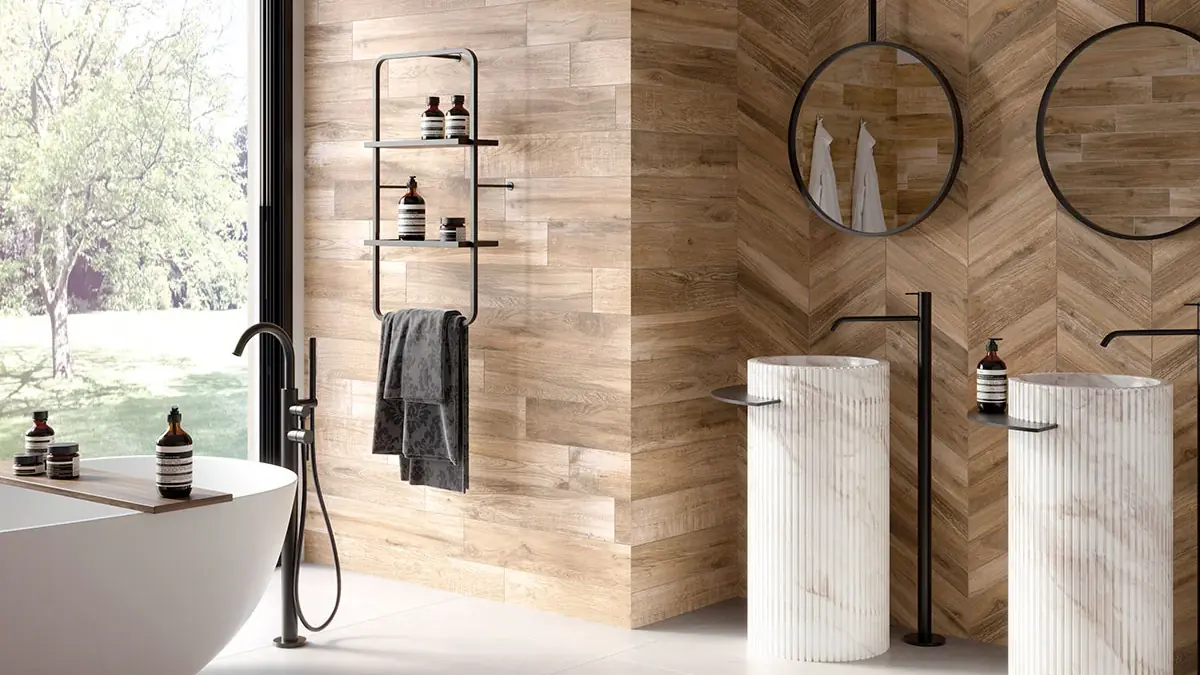
Herringbone wood effect porcelain tiles give you the timeless parquet look of a real herringbone wood floor in hard-wearing, waterproof porcelain that suits bathrooms, kitchens, hallways and underfloor heating, without the maintenance, water-sensitivity, scratching and fading of natural wood. The plank-shaped tiles are laid in the classic interlocking herringbone pattern to create warmth, movement and craft. It is one of the most requested luxury flooring looks we are asked for, because it combines the character of parquet with the practicality of porcelain. This guide covers where it works best, which plank sizes and laying patterns to choose, and how to get a premium finish.
Few flooring looks feel as quietly luxurious as a herringbone wood floor. It carries centuries of association with grand houses and considered design. The problem has always been that real wood is a poor choice for bathrooms and wet areas, and demanding to maintain anywhere. Herringbone wood effect porcelain solves that beautifully: the warmth and pattern of parquet, in a tile that shrugs off water, scratches and wear. Here is everything you need to choose and use it well.
What is herringbone wood effect porcelain?
Wood effect porcelain tiles are plank-shaped tiles, printed and textured to replicate the grain, tone and character of natural timber. Laid end to angled-end in the classic interlocking V, they recreate a herringbone parquet floor, one of the most enduring and elegant patterns in interior design.
The difference from real wood is what matters. Because these are porcelain, they are:
- Waterproof and suitable for bathrooms and wet rooms, where real wood cannot safely go.
- Hard-wearing and scratch-resistant, ideal for busy kitchens, hallways and homes with pets or children.
- Low maintenance, with no sanding, oiling or resealing, just normal cleaning.
- Compatible with underfloor heating, which real wood tolerates poorly.
So you get the look people love about parquet, with none of the compromises that usually rule it out of the rooms where it would look best.
Why herringbone works so well
The herringbone pattern is not just decorative. Its angled, interlocking geometry leads the eye and creates a sense of movement and energy that a straight plank layout cannot. A plain floor is static; a herringbone floor feels dynamic, crafted and intentional. Laid lengthways down a narrow room, it can even make the space feel longer and more generous.
Above all, herringbone reads as considered. It is the mark of a designed space rather than a merely floored one, which is exactly why it has signalled quality for centuries, from the parquet floors of stately homes to the timber-block floors of grand public buildings. Choosing it in wood effect porcelain brings that heritage into a modern, practical material.
Where herringbone wood effect porcelain works best
Unlike a small feature tile, herringbone wood effect porcelain is usually used across whole floors, where the pattern has room to breathe and become a genuine architectural statement.
Bathrooms and ensuites
This is where wood effect porcelain truly earns its place. You get the warmth of a wood floor in a room where real wood would warp and stain. A herringbone wood effect floor brings a spa-like, hotel-bathroom warmth that cool tiles can lack, and it pairs beautifully with marble-effect or stone-effect walls.
Wet rooms
With the right textured, slip-resistant finish, herringbone wood effect porcelain works even in a wet room, giving warmth underfoot in a space that is usually all hard, cool surfaces. It is a striking, practical choice.
Kitchens and open-plan living
In a kitchen or open-plan kitchen-diner, herringbone wood effect porcelain delivers the character of a parquet floor with the durability to handle spills, heavy traffic and dropped pans. Running it continuously through an open-plan space connects the zones and makes the whole area feel larger and more cohesive.
Hallways and entrances
A herringbone wood effect floor makes a warm, characterful first impression, and porcelain stands up to the grit, water and footfall a hallway takes far better than real wood ever could.
Plank sizes and proportions
The size and proportion of the planks change the character of a herringbone floor:
| Plank style | Character | Best for |
|---|---|---|
| Slim planks (e.g. 15x90cm) | Fine, detailed, traditional parquet feel | Classic schemes, smaller rooms |
| Medium planks (e.g. 20x120cm) | Balanced, contemporary | Most bathrooms and kitchens |
| Wide / long planks | Bold, modern, fewer joints | Large open-plan spaces |
Narrower planks give a finer, more intricate herringbone with more lines and a traditional feel. Wider planks create a bolder, more contemporary pattern with fewer grout lines. In a smaller bathroom, a slimmer plank often looks more refined; in a large open-plan area, a wider plank holds its own. Always view a sample laid out at the size and viewing distance of your room.
Herringbone laying patterns and variations
Even within herringbone, there are choices that change the look:
- Classic herringbone, planks set at 90 degrees to each other in the familiar interlocking V. The timeless default.
- Double herringbone, pairs of planks laid together for a bolder, larger-scale pattern.
- Herringbone with a border, a framing course around the edge of the room for a more formal, finished, parquet-floor look.
- Direction, laid straight down a room or on the diagonal. Lengthways can make a narrow room feel longer; diagonal adds the most energy.
Your fitter will also “dry lay” the planks first on a quality installation, arranging them before fixing so that the grain and tone vary naturally across the floor and no two near-identical planks sit side by side. This is what keeps the floor looking like real, varied timber rather than an obvious print.
Choosing the right wood tone
Wood effect porcelain comes in the full range of timber tones, and the tone sets the mood:
- Light oak and pale tones, airy, Scandinavian, contemporary. Brightens a room and suits smaller or darker spaces.
- Mid and natural oak, warm, versatile, the safe and popular middle ground.
- Dark walnut and smoked tones, rich, dramatic and characterful, best in larger or well-lit rooms.
- Grey and weathered tones, modern and cool, pairing well with contemporary fittings.
For a bathroom, lighter and mid tones tend to keep the space feeling open and spa-like, while a darker tone makes a bolder, more enveloping statement. The right choice depends on the room’s light, size and the look you are after.
Pairing herringbone wood effect floors with walls
A herringbone wood effect floor is a strong feature, so the walls around it should usually be calmer. Combinations our designers reach for:
- Herringbone wood effect floor with marble-effect walls, warm underfoot, elegant at eye level. A classic luxury bathroom pairing.
- Herringbone wood effect floor with stone or natural-stone-effect walls, a warm, natural, spa-like scheme.
- Herringbone wood effect floor with plain large-format walls, lets the floor be the hero in a contemporary space.
The principle is the same one good designers always follow: one feature, supported by calm surroundings. The herringbone floor provides the movement and craft; the walls provide the quiet backdrop.
Why porcelain beats real wood for herringbone floors
It is worth being clear about why wood effect porcelain has become the choice for herringbone floors over real parquet. Real wood is beautiful but, as a floor, it is demanding: it scratches and dents, it is damaged by water and humidity (ruling out bathrooms and wet rooms), it needs periodic sanding, oiling or resealing, and it reacts badly to underfloor heating.
Herringbone wood effect porcelain captures the look, the grain, the tone, the parquet pattern, in a material that is waterproof, hard-wearing, low maintenance and made for underfloor heating. You get the warmth and character of parquet in rooms where real wood simply could not go, and you never have to baby it. For most homes, that is a better deal: the look you love, without the compromises.
Herringbone wood effect porcelain vs the alternatives
People weighing up a herringbone wood floor usually consider a few options. Here is how porcelain compares:
| Option | Look | Water-safe? | Underfloor heating | Maintenance |
|---|---|---|---|---|
| Herringbone wood effect porcelain | Parquet look, very realistic | Yes, fully | Excellent | Minimal, no sealing |
| Real wood / engineered parquet | The genuine article | No (warps, stains) | Poor | High, sanding and resealing |
| Wood effect LVT (vinyl) | Convincing, softer underfoot | Mostly | Good | Low, but can dent and fade |
| Laminate | Budget wood look | No (swells if wet) | Variable | Low but not durable |
Against real wood, porcelain wins decisively for bathrooms, kitchens, wet areas and underfloor heating — the rooms where herringbone often looks best but where real timber fails. Against LVT and laminate, porcelain is more premium, far more durable, fully waterproof and will not dent, fade or swell, which is why it is the choice for a genuinely luxury finish. The one thing real wood offers that porcelain does not is the authenticity of natural timber underfoot, which some people specifically want and are willing to maintain. For most luxury bathroom and kitchen projects, though, herringbone wood effect porcelain is the more sensible and more practical luxury.
How much does a herringbone wood effect floor cost?
There are two parts to the cost: the tiles and the installation. Quality wood effect porcelain sits in the premium tile bracket — more than basic plain tiles but, crucially, far cheaper to live with than real parquet once you account for the sanding, oiling and resealing that timber needs over its life.
The thing to budget for with herringbone specifically is installation. Because every tile is set at an angle and the pattern has to be kept true across the room, a herringbone floor takes more time and skill to lay than straight planks, so fitting costs are higher than for a standard layout. It is worth it: a crisply laid herringbone floor is a genuine feature that lifts the whole room, and a poorly laid one undermines even the best tile. We always recommend investing in an experienced fitter for herringbone. Because porcelain then lasts for decades with almost no upkeep, the lifetime cost compares very well against real wood that needs regular refinishing.
A timeless choice, not a passing trend
One of the reassuring things about herringbone is that it is not a fad. The pattern has signalled quality and craftsmanship for centuries, long before modern interior trends, and it continues to feel current. Choosing it in wood effect porcelain brings that heritage into a practical, modern material that will not date the way a bolder, more fashionable choice might. It is the kind of floor that still looks right a decade later, which makes it a safe investment for a room you do not want to redo. That combination of timeless style and modern practicality is a big part of why we recommend it so often.
Installation: what to expect
A herringbone floor is more involved to lay than straight planks, because every tile is set at an angle and the pattern has to be kept perfectly true across the room. A few things make the difference between a crisp, professional result and an average one:
- A flat, well-prepared subfloor. Herringbone shows every imperfection beneath it, so preparation matters.
- An experienced fitter. Setting out a herringbone pattern accurately, keeping the angles true and planning where the pattern meets the walls, is skilled work. It is worth using someone who has done it before.
- Thin, tonally matched grout. As with all wood effect tiles, a grout colour close to the tile keeps the look seamless and natural. Wide or contrasting grout lines break the illusion of timber.
- Considered edges. How the pattern meets the walls — with a border or a neat cut — should be planned before work begins.
The tile does much of the work, but skilled installation is what elevates a herringbone wood effect floor from good to genuinely luxurious.
Caring for herringbone wood effect porcelain
This is one of the great advantages of porcelain: there is very little to do. No sanding, no oiling, no resealing — just regular sweeping and cleaning with a pH-neutral product. It will not scratch, stain or water-damage the way real wood does, and it keeps its appearance for decades. In a bathroom or wet room, wiping down and good ventilation keep limescale at bay, but otherwise a herringbone wood effect porcelain floor is essentially maintenance-free.
Common mistakes to avoid
A herringbone wood effect floor is a beautiful thing when it is done well, and a handful of avoidable errors are what separate a stunning result from a disappointing one:
- Using an inexperienced fitter. This is the big one. Herringbone is demanding to set out, and a fitter who has not done it before can end up with a pattern that drifts off true or meets the walls awkwardly. Insist on someone with herringbone experience.
- Bright or contrasting grout. Wide, pale grout lines break the illusion of timber and make the floor look like tiles pretending to be wood. A thin, tonally matched grout keeps it looking like a real parquet floor.
- Skipping the dry lay. Without arranging the planks first, you can end up with near-identical tones sitting side by side, which betrays the print. A good fitter dry-lays to vary the grain naturally.
- The wrong plank scale for the room. A very wide plank can overwhelm a small bathroom; a very fine plank can look busy across a large open-plan floor. Match the plank size to the space.
- Forgetting slip resistance in wet areas. For a bathroom or wet room floor, specify a textured, slip-resistant finish rather than a smooth one.
- Not planning the edges. Decide in advance how the pattern meets the walls — whether with a border or a clean cut — so the finish looks intentional rather than improvised.
Avoid these, and a herringbone wood effect porcelain floor delivers exactly what it promises: the warmth and craft of parquet, built to last.
A quick styling summary
To bring it together, the recipe for a beautiful herringbone wood effect floor is consistent: choose the plank size to suit the room (finer for smaller and traditional, wider for larger and contemporary), pick a wood tone that matches the room’s light and the mood you want, decide on a laying variation (classic, double, or with a border), keep the surrounding walls calm so the floor is the feature, use thin, tonally matched grout, and invest in an experienced fitter. Follow that, and you get a floor with genuine character and craft, warm underfoot, waterproof, and built to look beautiful for decades.
Frequently asked questions
What are herringbone wood effect tiles?
They are plank-shaped porcelain tiles printed to look like timber, laid in the classic interlocking herringbone (parquet) pattern. They give the look of a herringbone wood floor with the durability and water resistance of porcelain.
Can you use herringbone wood effect porcelain in a bathroom?
Yes. Because the tiles are porcelain, they are waterproof and ideal for bathrooms and even wet rooms, where real wood cannot safely go. Choose a textured, slip-resistant finish for wet areas.
Is wood effect porcelain better than real wood flooring?
For bathrooms, kitchens, hallways and underfloor heating, yes. Wood effect porcelain is waterproof, scratch-resistant, low maintenance and works with underfloor heating, while real wood scratches, is water-sensitive and needs periodic resealing. Real wood still appeals to those who specifically want natural timber and accept its upkeep.
What size planks are best for a herringbone floor?
Slimmer planks give a finer, more traditional parquet look and suit smaller rooms; wider planks give a bolder, more contemporary pattern with fewer grout lines and suit larger spaces. Medium planks (around 20x120cm) are a popular, balanced choice for most bathrooms and kitchens.
Does herringbone wood effect porcelain work with underfloor heating?
Yes, porcelain is an excellent conductor and a great partner for underfloor heating, giving you a warm, characterful floor underfoot. This is a major advantage over real wood, which tolerates underfloor heating poorly.
Is a herringbone floor harder to install?
Yes, it takes more skill and time than straight planks because each tile is set at an angle and the pattern must be kept true. It is worth using an experienced fitter for a crisp, professional result.
What wall tiles go with a herringbone wood effect floor?
Calmer, larger-format walls let the floor be the feature. Marble-effect walls give an elegant luxury pairing, stone or natural-stone-effect walls give a warm, spa-like scheme, and plain large-format tiles suit a contemporary look.
Is herringbone wood effect porcelain worth the extra cost over straight planks?
For many homes, yes. The tiles cost the same whether laid straight or in herringbone, so the extra outlay is in the fitting, because the pattern takes more time and skill to set true. What you gain is a floor with genuine character that lifts an entire room. Spend the pattern budget where it will be seen every day — a hallway, bathroom or open living space — and choose straight planks for low-traffic rooms.
See herringbone wood effect porcelain at our Watford showroom
A herringbone floor is something you really need to see laid out — the pattern, the plank size and the wood tone all change the effect, and they are hard to judge from a sample chip or a screen. Visit our Watford showroom to see herringbone wood effect porcelain in a range of tones and plank sizes, and let our award-winning team help you choose the right combination for your bathroom, kitchen or living space.