
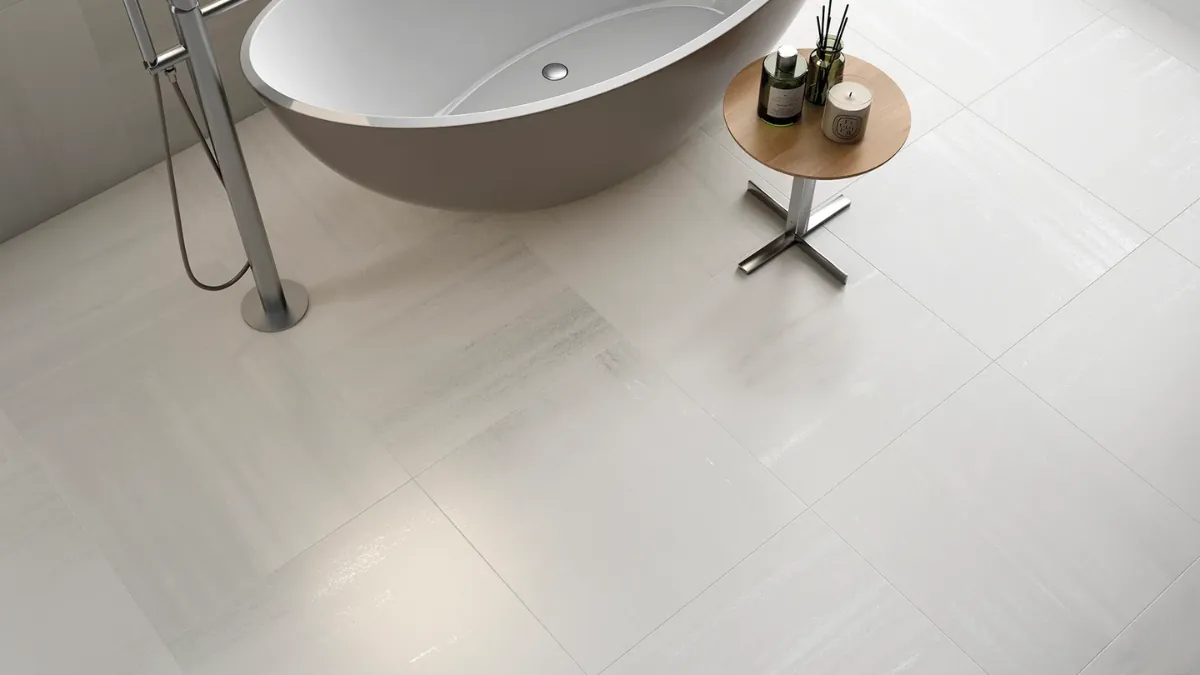
The best tile size for a small bathroom is large-format — typically 600×600mm on the floor and 600×1200mm on the walls — laid with thin, tonal grout lines. This runs counter to the old “small room, small tiles” advice: fewer grout lines create a calmer, more continuous surface that makes the room read as bigger, not smaller. The main exception is the shower floor, where a small-format mosaic is often the better technical choice for grip and drainage falls, and a slim brick or metro tile can work as a deliberate feature elsewhere.
It’s one of the most persistent myths in bathroom design: that a small room needs small tiles to avoid feeling overwhelmed. In practice, the opposite is almost always true. Our design team at Design Di Lusso explains why large-format tiles are usually the right call in a compact bathroom, where the genuine exceptions are, and how to get the details — grout colour, edge finish, tone — right so the room feels as spacious as possible.
Do large tiles make a small bathroom look bigger?
Yes. The logic comes down to grout lines. Every grout joint is a visual break — a place where the eye registers an edge and the brain reads the surface as segmented. Tile a small bathroom in lots of small tiles, and you cover it in a dense grid of joints that fragments the space and emphasises exactly how compact it is. Swap to large-format tiles, and most of those joints disappear. Floors and walls read as continuous planes, the eye travels further before hitting an interruption, and the room feels calmer and more expansive — even though the actual floor area hasn’t changed at all.
Best tile size by bathroom zone
| Zone | Recommended size | Why |
|---|---|---|
| Main floor | 600×600mm | Large enough to minimise grout lines, manageable for most room shapes |
| Walls | 600×1200mm | Vertical orientation elongates the room and adds height |
| Shower / wet-zone walls | 600×1200mm | Fewer joints for a more waterproof, easier-to-clean surface |
| Shower floor | Small mosaic (typically 25–50mm) | Needed for slip grip and to follow drainage falls |
| Feature / niche | Smaller format or mosaic | Deliberate contrast and detail in a contained area |
What size floor tile is best?
For most small bathrooms, 600×600mm is the sweet spot — large enough to dramatically cut grout lines compared with traditional 300×300mm tiles, while remaining practical to cut around a WC, bath and door threshold without excessive waste. Where the room shape allows and the substrate is properly prepared, 600×1200mm can push the seamless effect even further, particularly in a longer, narrower room.
One caution: the larger the tile, the flatter the substrate needs to be. A floor with dips or humps will show “lippage” — one tile edge sitting proud of its neighbour — so a properly levelled substrate is non-negotiable before specifying anything above 600×600mm.
What about wall tiles?
600×1200mm laid vertically is the default recommendation for small bathroom walls, because a tall, narrow format draws the eye upward and adds a sense of height to a room that often lacks it. This is one of the few cases where orientation matters as much as size.
The deliberate exception is a metro or slim brick tile, used knowingly as a feature rather than a default. A run of glossy or textured metro tiles on one wall, laid in a classic brick bond, can add texture and character to an otherwise pared-back scheme — but it works because it’s a considered choice, not because “small room needs small tile.”
Does grout colour matter as much as tile size?
Yes — arguably just as much. A large tile with a strong, contrasting grout colour reintroduces the very grid pattern you were trying to avoid by going large-format in the first place. Tonal grout — matched closely to the tile colour — is critical: it lets the joints recede visually so the surface reads as close to seamless as installation allows. Get the tile size right and the grout colour wrong, and you’ve undermined the entire effect.
Why do rectified edges matter?
Rectified tiles are precision-cut after firing so every edge is perfectly straight and uniform, which allows them to be laid with much thinner grout joints — typically around 2mm, compared with 3–5mm for standard non-rectified tiles. In a small bathroom aiming for a continuous, large-format look, that difference is significant: thinner joints mean less visual “noise” and a more expensive, seamless finish overall. When specifying large-format tiles for a compact room, rectified edges should be considered close to essential.
What tone and finish work best?
Beyond size, a few further choices help a small bathroom feel as spacious as possible:
- Lighter, softer tones reflect more light and read as more open than dark, saturated colours.
- Low contrast between tile and grout keeps the surface calm rather than gridded.
- Finish matters for light management — a matt or honed finish diffuses light softly, while a polished finish bounces more light around a naturally dim room, both valid depending on the mood you want.
- Carry one tile through the room — using the same tile on the floor and walls, or at least the same tone, removes another visual break and reinforces the sense of one continuous space.
Where is a small tile actually right?
Large-format is the right default, but there are genuine cases where a smaller tile is the better technical or design choice:
- Shower floors, where a mosaic’s many grout lines provide essential slip grip and allow the tiler to follow the gentle falls needed for drainage — something a rigid large-format tile cannot do.
- A deliberate feature, such as a patterned mosaic niche, a fluted or metro accent wall, or a decorative border, used knowingly as a contrast to an otherwise large-format scheme.
- Curved surfaces, such as a rounded shower wall or bath panel, where a smaller tile can follow the curve more easily than a large, rigid one.
- Period or restoration projects, where small-format or mosaic tiling is part of the authentic character being preserved or referenced.
How to avoid common mistakes
- Don’t default to small tiles “because the room is small” — it’s usually the opposite of what will make it feel bigger.
- Don’t pair large-format tiles with a strongly contrasting grout colour — it cancels out the benefit.
- Don’t skip substrate preparation — large tiles need a genuinely flat floor and wall to avoid lippage and cracking.
- Don’t mix too many tile sizes and finishes in one small room — it reintroduces visual clutter.
- Don’t forget slip safety on the shower floor — large-format is rarely the right call there.
- Don’t ignore orientation on walls — vertical-laid rectangular tiles add height that horizontal laying doesn’t.
Frequently asked questions
What is the best tile size for a small bathroom floor?
600×600mm is the most practical choice for most small bathrooms, with 600×1200mm an option in longer, narrower rooms where the substrate can be properly levelled.
Do small tiles make a small bathroom look bigger?
No — the opposite is generally true. Small tiles create more grout lines, which fragments the visual space and makes a small room feel busier and more compact, not larger.
What size should wall tiles be in a small bathroom?
600×1200mm laid vertically is the usual recommendation, as the tall format and orientation help draw the eye upward and add a sense of height.
Should shower floor tiles be the same size as the rest of the bathroom?
Usually not. Shower floors typically need a small-format mosaic for slip grip and to allow the tiler to create the falls needed for drainage, even when the rest of the room uses large-format tiles.
Does grout colour affect how big a bathroom looks?
Yes, significantly. Tonal grout that closely matches the tile lets joints recede visually, while a strongly contrasting grout reintroduces a grid pattern that can make a room feel smaller and busier.
Are rectified tiles worth it in a small bathroom?
Yes — their precision-cut edges allow much thinner grout joints (around 2mm versus 3–5mm), which meaningfully reduces the amount of visible grout in a large-format installation.
Can you use large tiles in a really tiny bathroom or cloakroom?
Yes, and it often works particularly well — the fewer joints a large tile creates, the calmer a very small space feels, provided the substrate is flat enough and cuts around fixtures are planned carefully.
What tile finish is best for a small, dark bathroom?
A polished or gloss finish reflects more available light around the room, which can help a naturally dim space feel brighter, while a matt or honed finish gives a softer, more contemporary look.
The bottom line
Large-format tiles, thin tonal grout and rectified edges are the combination that makes a small bathroom feel genuinely bigger — not a smaller tile crammed into a smaller room. Reserve small-format and mosaic tiles for where they earn their place: shower floors, curves and deliberate features. Get the size, grout and tone right together, and even the most compact ensuite or cloakroom can feel like a considered, high-end space.
Come and see large-format tiles at full size in our showroom — scale is something no photograph can properly convey.