
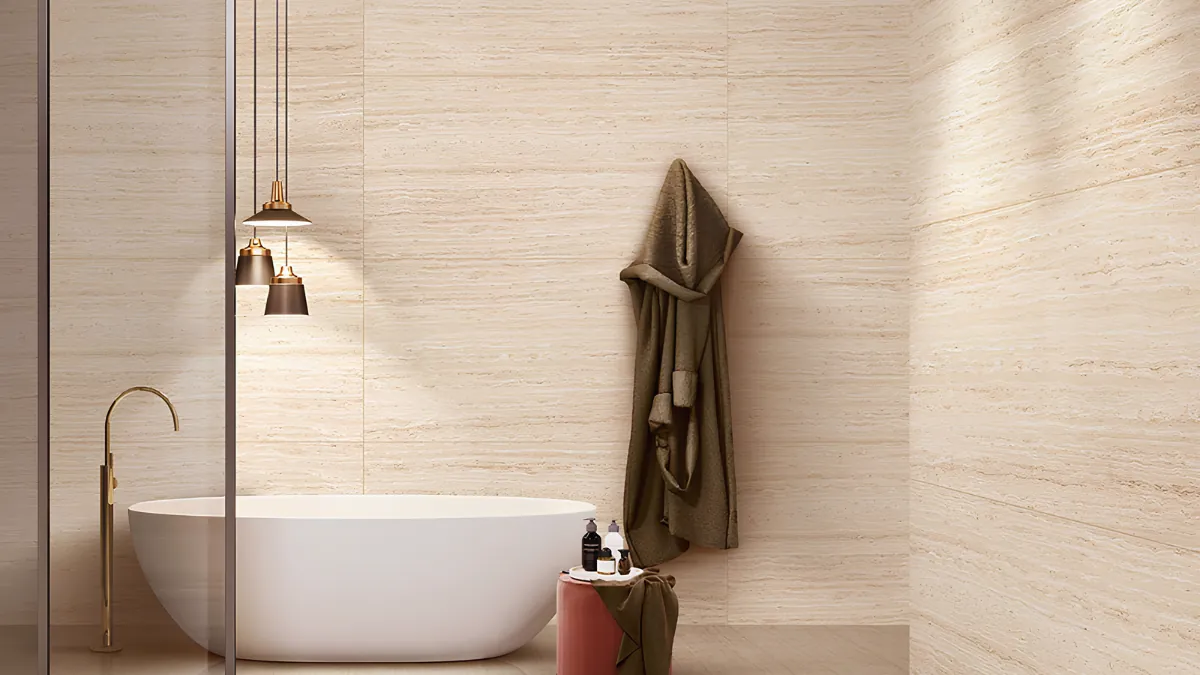
For most homes, stone-effect porcelain is the better choice: it’s non-porous (water absorption below 0.5%), never needs sealing, is frost-proof, and resists stains, acid and scratches far more effectively than natural stone. Real natural stone still wins where authenticity and one-off natural variation genuinely matter — dry, decorative, purist projects where a piece of real quarried material is the point. For nearly every bathroom, kitchen and wet area, though, stone-effect porcelain delivers the look with a fraction of the maintenance and none of the sealing.
Natural stone has an undeniable pull — the sense of a genuine, quarried material with its own unrepeatable history. But it also comes with a maintenance commitment that catches many homeowners out after the fact: ongoing sealing, careful cleaning products, and vulnerability to acid and staining that porcelain simply doesn’t share. Our design team at Design Di Lusso lays out the real, practical differences so you can choose with your eyes open, not just your eye for a beautiful slab.
What is stone-effect porcelain vs natural stone?
Stone-effect porcelain is a fully fired, vitrified porcelain tile finished with a high-definition printed reproduction of a natural stone pattern, then often textured to replicate the tactile surface of the real material. Natural stone is genuine quarried material, cut and finished into tiles or slabs — the classics being travertine, limestone, marble and slate, each with its own natural variation, porosity and character that no two pieces share exactly.
Do stone tiles need sealing? The single biggest difference
This is the difference that matters most in daily life. Natural stone must be sealed, and re-sealed for the life of the installation — it’s a genuinely porous material, and without a sealant it will absorb water, oils and staining agents, particularly in a bathroom or kitchen. Porcelain, by contrast, never needs sealing, at any point, because its water absorption sits below 0.5% straight from the factory. Anyone who has owned a natural stone floor and had to schedule periodic resealing will recognise immediately what a difference this makes to long-term maintenance.
Full comparison
| Factor | Stone-effect porcelain | Natural stone |
|---|---|---|
| Porosity | Non-porous (<0.5% absorption) | Porous, varies by stone type |
| Sealing | Never needed | Required, and ongoing |
| Maintenance | Minimal — sweep and mop | Regular — resealing, careful cleaning |
| Durability | Excellent, scratch and stain resistant | Good but softer, can etch and stain |
| Frost resistance | Excellent, frost-proof | Varies, some types vulnerable |
| Look / authenticity | High-fidelity reproduction | Genuinely one-of-a-kind |
| Indoor-outdoor continuity | Excellent, matched twin ranges available | Possible, but heavier and needs sealing outdoors too |
| Cost to buy | Mid to premium | Premium to very high |
| Cost to live with | Low ongoing cost | Higher — sealing, specialist products |
| Best use | Bathrooms, kitchens, wet areas, most homes | Dry, decorative, purist projects |
Which natural stone looks can porcelain reproduce?
| Natural stone | Porcelain reproduction character |
|---|---|
| Travertine | Warm, tonal, softly pitted texture reproduced convincingly |
| Limestone | Soft, muted, low-contrast pattern well suited to printing |
| Marble | Bold veining reproduced with high fidelity in premium ranges |
| Slate | Textured, layered look reproduced with matching surface texture |
| Sandstone | Warm, grainy tone reproduced accurately at large format |
Which is more durable?
Porcelain, generally, by a clear margin. Its fired, vitrified body resists scratching, staining and acid etching far better than most natural stone — marble in particular is notoriously vulnerable to etching from anything acidic, from lemon juice to certain cleaning products, leaving a permanent dull mark. Porcelain shrugs off the same exposure without a mark. Over years of daily use, especially in a busy kitchen or family bathroom, that durability gap becomes very noticeable.
Can you use the same tile indoors and outdoors?
Yes — this is porcelain’s quiet superpower. Many premium stone-effect ranges are produced as a matched twin: a 10mm indoor tile and a 20mm outdoor tile sharing the same look, allowing a genuinely seamless flow from an indoor floor out to a terrace. Natural stone can technically be used outdoors too, but it still requires sealing outside, is heavier to handle, and is more vulnerable to frost damage depending on the stone type.
Are stone-effect tiles slippery?
It depends on the finish, exactly as with natural stone. A polished stone-effect porcelain tile will be slippery when wet, just as polished natural marble is — so for wet areas, specify a matt, honed or textured finish with a suitable slip rating (typically R10-R11), reserving polished finishes for walls and dry areas.
Do stone-effect tiles look fake?
Not in premium ranges — and the reasons why are worth understanding. Early or budget stone-effect tiles sometimes suffered from three tell-tale problems that gave printed tile a bad reputation: obvious pattern repetition across just a handful of designs, a flat, glossy print that didn’t match the tactile surface of real stone, and a uniform texture that felt nothing like natural variation underfoot. Premium ranges have solved all three: modern high-definition printing uses many more unique face designs to avoid repetition, surface texturing is matched to the print to replicate real tactile depth, and finishes now vary subtly across a batch the way real stone naturally does. Seen and touched in person, today’s top ranges are genuinely difficult to distinguish from the real material.
Where natural stone still wins
Being honest about the trade-offs matters, and natural stone does still have a legitimate place:
- True authenticity. For some clients and some projects, the fact that a surface is genuinely quarried stone — not a reproduction — is the entire point, regardless of the maintenance involved.
- One-off variation. No printed tile, however sophisticated, can replicate the truly random, never-repeating variation of natural stone across a full installation.
- Tactile patina. Natural stone develops a genuine patina and character over decades of use in a way a manufactured surface, by definition, cannot.
- Dry, low-traffic settings. In a space with minimal water exposure and light use, natural stone’s maintenance burden is far less of a practical issue.
Cost comparison
Stone-effect porcelain generally costs less to buy than premium natural stone, and significantly less to live with over time, since it needs no sealing, no specialist stone-care products and no periodic professional resealing. Natural stone commands a higher price both at purchase and across its lifetime, reflecting its rarity, the extraction and finishing process, and the ongoing maintenance it demands — a cost that’s easy to underestimate at the point of purchase.
Best-practice checklist
- Choose porcelain for any wet area — bathrooms, wet rooms, kitchen floors — where low maintenance and waterproofing matter most.
- Choose porcelain for indoor-outdoor continuity, using matched twin thickness ranges.
- Reserve natural stone for dry, low-traffic, decorative applications where authenticity is the priority.
- If specifying natural stone, budget for ongoing sealing and specialist cleaning products from day one.
- Always see stone-effect porcelain in person before deciding — the surface texture and finish quality vary significantly between ranges.
When we still specify natural stone, and how it’s detailed
Our design team does still specify genuine natural stone for certain projects — typically where a client specifically wants an authentic, one-off material, in a dry or low-traffic setting such as a feature wall, a hallway, or a bathroom where wet-area durability is less of a concern. In these cases, we detail it properly: a suitable sealant applied and maintained on a defined schedule, an appropriate finish for the location, and clear guidance for the homeowner on ongoing care, so the beauty of the material is matched by a realistic understanding of what it needs.
Why see stone-effect porcelain before buying
The quality gap between a budget stone-effect tile and a premium one is significant, and it’s very hard to judge from an online photograph or a small sample swatch. Seeing a full-size tile under proper lighting, and touching the surface texture directly, is the only reliable way to judge whether a range will genuinely pass for natural stone in your finished room.
Frequently asked questions
Is stone-effect porcelain as good as real stone?
For most homes, it’s better in practical terms — equally beautiful in premium ranges, but without the ongoing sealing, staining risk and specialist maintenance that natural stone requires.
Does stone-effect porcelain need sealing?
No — porcelain’s water absorption is below 0.5%, so it never needs sealing, unlike natural stone which must be sealed on installation and periodically resealed thereafter.
Can stone-effect tiles be used outdoors?
Yes, and many ranges offer a matching outdoor-rated twin tile at 20mm thickness, allowing a seamless look from an indoor floor out to a terrace.
Does marble-effect porcelain look realistic?
In premium ranges, yes — modern high-definition printing and matched surface texturing make top-tier marble-effect porcelain very difficult to distinguish from real marble.
Is natural stone more expensive than stone-effect porcelain?
Generally yes, both to buy and to maintain over time, once sealing, specialist cleaning products and periodic resealing are factored into the total cost.
Why does natural stone need sealing but porcelain doesn’t?
Natural stone is a genuinely porous material that absorbs water and staining agents without a sealant, while fired porcelain has a water absorption rate below 0.5%, effectively eliminating the porosity a sealant would need to address.
Is travertine-effect porcelain a good alternative to real travertine?
Yes — it reproduces travertine’s warm tone and softly pitted texture convincingly, while eliminating the ongoing sealing and staining vulnerability that real travertine carries.
Does stone-effect porcelain scratch or stain?
It’s highly resistant to both, thanks to its dense, fired, non-porous body, whereas natural stone — particularly marble and limestone — is more vulnerable to scratching, staining and acid etching.
Can you tell the difference between stone-effect porcelain and real stone?
In budget ranges, sometimes, due to pattern repetition or a flat print. In premium ranges with matched texturing and varied face designs, the difference is genuinely difficult to spot, even up close.
Is stone-effect porcelain slippery?
It depends on the finish — polished stone-effect porcelain is slippery when wet, so a matt, honed or textured finish with a suitable slip rating should be specified for any wet area.
Does stone-effect porcelain work with underfloor heating?
Yes, very well — porcelain’s high thermal conductivity makes it an excellent UFH floor finish, performing at least as well as, and often better than, natural stone in this respect.
What’s the biggest downside of choosing natural stone?
The ongoing maintenance commitment — sealing on a recurring schedule, careful choice of cleaning products, and vulnerability to staining and etching that simply isn’t a factor with porcelain.
Is real natural stone ever worth choosing over porcelain?
Yes, for projects where genuine authenticity and truly one-off natural variation are the priority, typically in dry, low-traffic, decorative settings rather than busy wet areas.
Stone-effect porcelain and long-term value
Over the lifetime of a bathroom or kitchen, the case for stone-effect porcelain strengthens further: no resealing bills, no risk of an acidic spill permanently etching a worktop or floor, and consistent performance in wet, high-traffic areas year after year. For the overwhelming majority of homes, it delivers the beauty of natural stone with a genuinely lower total cost of ownership — which is exactly why it has become the default specification in luxury bathroom design.