
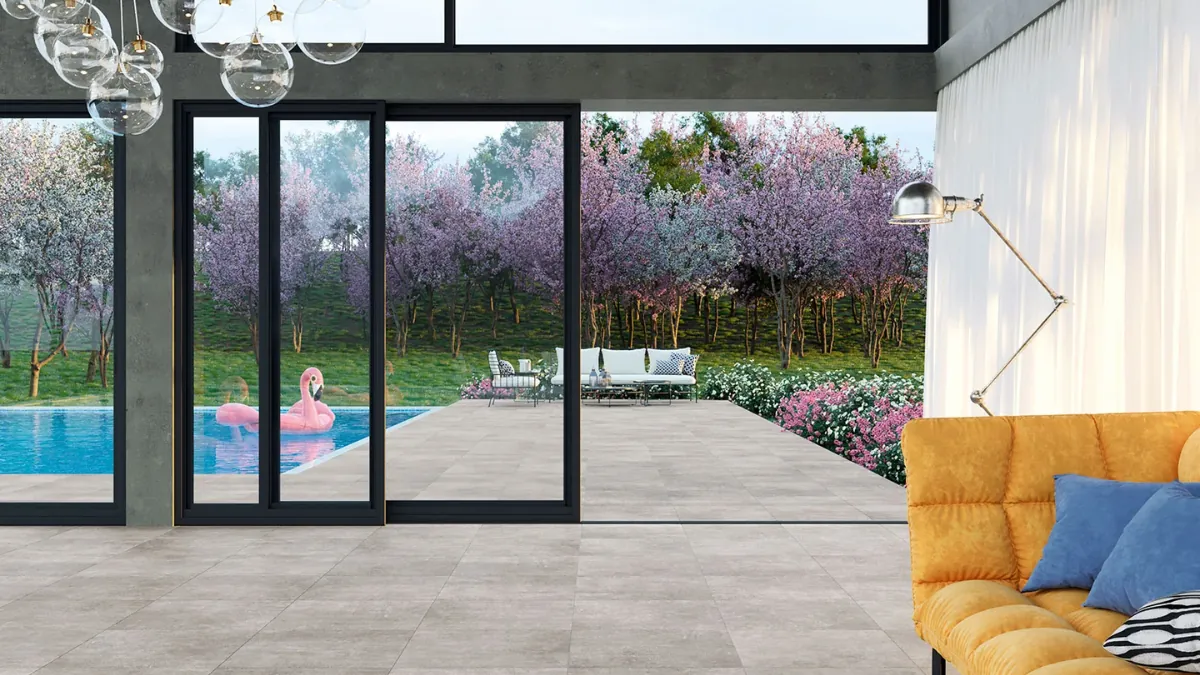
Technically, yes, outdoor porcelain tiles can be used indoors, but it’s rarely recommended: the standard 20mm thickness is heavier and harder to work with than necessary indoors, and the coarse, grippy finish designed for wet, weathered outdoor conditions is overkill underfoot inside. The reverse — using indoor porcelain outdoors — is a firm no: 10mm indoor tiles lack the structural thickness and slip rating to perform safely in an exterior setting. The best practice for a genuine indoor-outdoor look is to specify matching twin tiles from the same range: a 10mm indoor version and a 20mm outdoor version sharing the same face, colour and finish.
The desire to run one continuous floor from a kitchen straight out onto a terrace is one of the most requested looks in luxury home design — and it’s entirely achievable. But it needs the right approach, because indoor and outdoor porcelain, despite often looking near-identical in a catalogue, are engineered for very different jobs. Our design team at Design Di Lusso explains the real difference, why swapping one for the other rarely works well, and how to get a genuinely seamless indoor-outdoor result.
Are indoor and outdoor tiles the same tile?
Often, yes, in the sense that many premium ranges are produced as a matched pair — the same design, colour and surface pattern, manufactured in two different specifications. The tile body can be very similar or identical in composition. What changes between the indoor and outdoor version is thickness and surface finish, both engineered specifically for where the tile will be walked on.
Can you use outdoor porcelain indoors?
Technically, yes — but it’s rarely the right call, for three practical reasons:
- Thickness and floor levels. Outdoor porcelain is typically 20mm thick, roughly double the 10mm standard for indoor tiles. Laid indoors, that extra thickness creates a step up at every threshold and complicates matching floor heights with adjoining rooms.
- Finish and cleaning. Outdoor tiles have a deliberately coarse, textured surface for slip resistance in wet, weathered conditions. Indoors, that same texture is harder to keep clean, can feel unpleasantly rough underfoot in bare feet, and doesn’t suit the sleeker, smoother look most interior schemes want.
- Overkill. The extra thickness and structural strength that outdoor porcelain is built for — withstanding frost, ground movement and heavy foot traffic on an unsupported base — simply isn’t needed on an indoor floor with proper support underneath.
Can you use indoor porcelain outdoors?
No — and this direction is more clear-cut than the reverse. Indoor porcelain at 10mm lacks the structural thickness to handle exterior conditions: ground movement, frost, and the load of being laid on a semi-flexible outdoor base like sand or pedestals, rather than a supported indoor screed. It also lacks the slip rating outdoor conditions demand — most indoor tiles are finished smooth or polished for a premium look, which becomes genuinely dangerous when wet. Using indoor tile outside risks both structural failure over time and a real safety hazard underfoot.
Indoor vs outdoor tile specification
| Factor | Indoor (10mm) | Outdoor (20mm) |
|---|---|---|
| Thickness | ~10mm | ~20mm |
| Slip rating | Lower, not exterior-rated | High — R11/R10-R11, PTV-rated |
| Finish | Smooth, satin, polished | Textured, grippy, matt |
| Primary use | Floors and walls indoors | Patios, terraces, pool surrounds |
| Installation | Fixed with adhesive on screed | Can be laid on adhesive, sand or raised pedestals |
| Frost resistance | Not required / not rated | Frost-proof, engineered for exterior exposure |
| Best where | Kitchens, bathrooms, living spaces | Gardens, balconies, terraces, driveways |
What is “seamless indoor-outdoor flow”?
It’s the effect of a floor that appears to run uninterrupted from inside a home straight out to a terrace or garden, typically through a set of bifold or sliding doors. Achieving it properly means specifying a matched pair — the 10mm indoor and 20mm outdoor versions of the same tile range, sharing identical colour, pattern and surface design, so the visual continuity holds even though the technical specification underfoot changes at the threshold.
How do you get the levels to line up at the door?
This is the detail that makes or breaks a seamless transition, and it needs to be planned at the substrate stage, well before tiling begins. Because outdoor tiles are roughly double the thickness of indoor ones, the outdoor sub-base typically needs to sit correspondingly lower than the indoor screed so the two finished surfaces meet flush at the threshold. A drainage threshold or shallow channel at the door is also usually needed, both to manage water run-off from outside and to accommodate any small changes in level without creating a trip hazard.
Do the tiles have to be exactly the same size?
Not necessarily, but matching the format and grid — the length and width, even if thickness differs — makes the transition look far more deliberate and seamless, since grout lines can align across the threshold rather than jumping to a different pattern. Large-format tiles particularly help here, since fewer, bigger tiles mean fewer grout lines to align and a calmer, more continuous read from inside to out.
Where NOT to use each tile
- Outdoor porcelain on an indoor bathroom floor — unnecessarily thick, coarse to clean, complicates level matching with the rest of the house.
- Indoor porcelain on a patio or terrace — inadequate structural thickness and slip rating for exterior, weathered conditions.
- Indoor tile on a balcony or roof terrace — exposed to the same frost and weathering risk as ground-level exterior spaces.
- Outdoor tile as a shower floor — coarse outdoor finishes aren’t designed for barefoot indoor wet-room use and are harder to keep hygienically clean.
- Mismatched, non-twinned ranges for an indoor-outdoor scheme — even close colour matches from different ranges rarely align in pattern, tone and grout line as convincingly as a genuine matched pair.
What does it cost?
Outdoor 20mm porcelain generally costs more per square metre than the indoor 10mm equivalent from the same range, reflecting the extra material and the engineering required for frost resistance and slip rating. Specifying a full matched indoor-outdoor scheme — both thicknesses from one range, correctly detailed levels at the threshold, and professional installation on both sides — is a bigger investment than tiling either area alone, but it’s one of the most effective ways to add a genuine sense of scale and luxury to a home, extending the living space visually into the garden.
Frequently asked questions
Can I use the same porcelain tile inside and outside my house?
Yes, provided you specify the matched pair from the same range — the 10mm indoor version inside and the 20mm outdoor version outside — rather than using one thickness in both locations.
Why is outdoor porcelain thicker than indoor porcelain?
The extra thickness (around 20mm versus 10mm) gives outdoor tiles the structural strength to handle ground movement, frost and being laid on more flexible outdoor bases such as sand or pedestals.
Is it dangerous to use indoor tiles outside?
Yes — indoor tiles generally lack both the slip rating needed for wet exterior conditions and the structural thickness to withstand frost and outdoor ground movement over time.
Can outdoor tiles be used on an indoor floor?
Technically yes, but it’s not usually recommended — the extra thickness complicates matching floor levels with adjoining rooms, and the coarse outdoor finish is harder to clean and less comfortable underfoot indoors.
How do you match indoor and outdoor tile levels at a doorway?
By planning the sub-base height at the substrate stage — the outdoor base typically sits lower than the indoor screed to account for the outdoor tile’s extra thickness, often with a drainage threshold at the door.
Do indoor-outdoor tiles need to be the same colour?
Ideally yes — using the matched indoor and outdoor versions of the same range ensures the colour, pattern and finish align, creating a genuinely seamless visual transition.
What slip rating do outdoor tiles need?
Outdoor tiles are typically rated R10-R11 or higher, or given a PTV (pendulum test value) rating, both measures of slip resistance suited to wet, weathered exterior conditions.
Can outdoor porcelain be laid on sand or pedestals?
Yes — the 20mm thickness gives outdoor porcelain the structural strength to be laid on adhesive, compacted sand, or raised pedestal systems, none of which are suitable for thinner indoor tile.
The bottom line
Indoor and outdoor porcelain are built for different jobs, and swapping one for the other — in either direction — creates practical problems, from awkward floor levels to genuine slip hazards. For a true seamless indoor-outdoor look, specify the matched 10mm/20mm twin pair from the same range and plan the threshold levels at the substrate stage. Done properly, it’s one of the most impressive upgrades a home can have.