
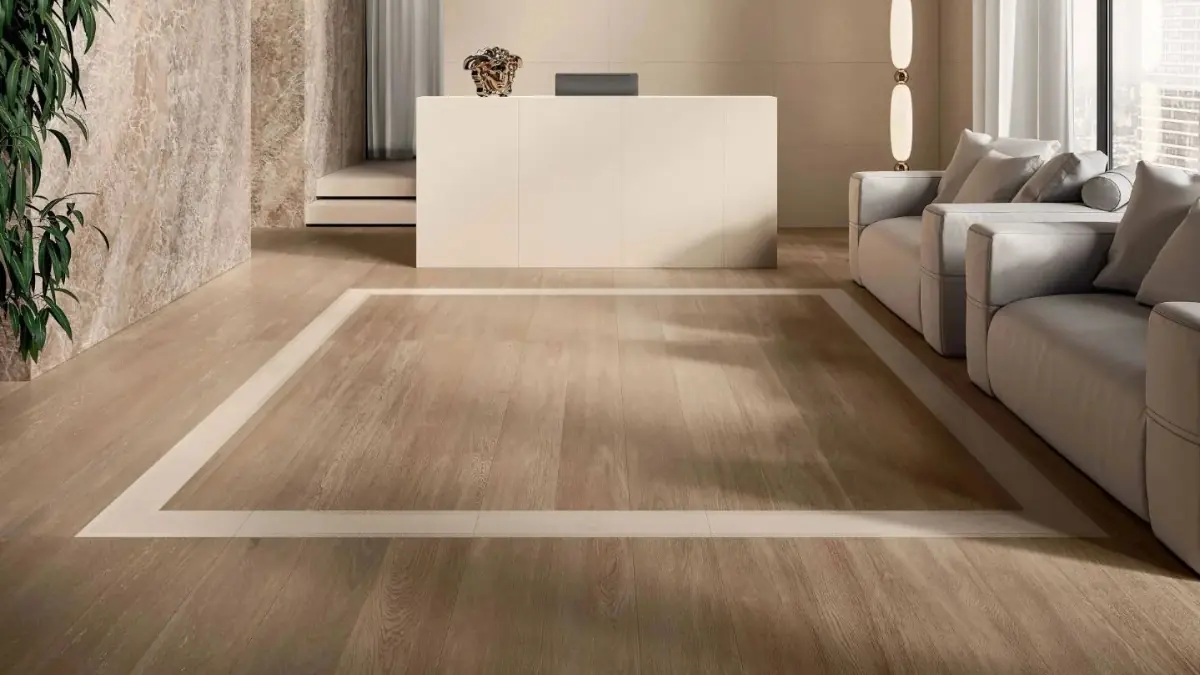
Yes, wood-effect porcelain tiles are better than real wood flooring for bathrooms, kitchens, wet rooms and any room with underfloor heating: they’re waterproof (water absorption below 0.5%), scratch- and dent-resistant, and fully compatible with UFH, none of which real wood can offer. Real wood still wins on genuine underfoot warmth and tactile character in dry, low-traffic, unheated rooms where authenticity matters more than practicality. For most modern homes, especially anywhere near water or heat, wood-effect porcelain is the smarter long-term choice.
It’s a question we field constantly from clients who love the warmth of a wood floor but are nervous about specifying it in a bathroom, kitchen or over underfloor heating — for good reason. Real wood and water have never got along, and neither does real wood with a heated screed. Wood-effect porcelain was developed specifically to solve that tension, and the technology has come a long way. Our design team at Design Di Lusso breaks down exactly how the two compare, room by room, so you can decide with your eyes open.
What are wood-effect porcelain tiles?
Wood-effect porcelain is a fully fired, vitrified porcelain tile finished with a high-definition inkjet-printed image of real wood grain, then surface-textured to replicate the tactile feel of timber — including the subtle ridges of brushed oak or the grain lines of reclaimed board. They’re typically produced in plank formats (long, narrow rectangles) that mimic real floorboards, laid in a running bond or herringbone pattern for maximum authenticity.
Because the printing technology has advanced so far, premium ranges reproduce knots, colour variation and grain direction with a level of realism that’s very difficult to distinguish from real timber at a glance — while the underlying material remains 100% porcelain.
Wood-effect porcelain vs real wood vs laminate/LVT
| Factor | Wood-effect porcelain | Real wood | Laminate / LVT |
|---|---|---|---|
| Water resistance | Waterproof (<0.5% absorption) | Poor — swells, warps, stains | Variable — LVT good, laminate poor |
| Suitable for bathrooms | Yes, ideal | No | LVT yes, laminate no |
| Durability | Excellent — scratch and dent resistant | Good but scratches, dents easily | Moderate — surface layer can wear |
| Underfoot warmth | Cooler unless heated | Naturally warm | Warmer than tile, cooler than wood |
| Underfloor heating | Excellent — ideal conductor | Poor — risk of warping | Limited — temperature caps apply |
| Maintenance | Minimal — sweep and mop | Regular — oiling, refinishing | Low, but can’t be refinished |
| Fade resistance | Excellent, UV-stable | Fades and ambers over time | Can fade or discolour |
| Scratch resistance | Excellent | Poor to moderate | Moderate |
| Lifespan | Decades | Decades, with refinishing | 10–20 years |
| Cost | Mid to premium | Premium | Budget to mid |
Are wood-effect tiles any good? An honest scorecard
Where wood-effect porcelain is genuinely outstanding:
- Fully waterproof — impervious to splashes, spills, steam and standing water.
- Scratch- and dent-proof — shrugs off dropped pans, pet claws and moved furniture in a way timber never can.
- Virtually zero maintenance — no oiling, sanding, sealing or refinishing, ever.
- Colourfast — won’t fade, amber or discolour with age or sunlight.
- Underfloor-heating friendly — porcelain is an excellent thermal conductor, making it one of the best UFH floor finishes available.
The honest trade-offs:
- Cooler and harder underfoot when unheated — this is the genuine weak spot compared with timber.
- Not quite the real tactile feel of timber grain underfoot, however good the surface texturing.
- Needs a skilled installation to lay plank-format porcelain correctly, particularly in herringbone patterns.
Are wood-effect tiles good for bathrooms?
Yes — and here there’s no serious competition. Real wood simply cannot be specified safely in a wet bathroom or shower room: moisture causes swelling, cupping and eventually rot, however well it’s sealed. Wood-effect porcelain delivers the warm, natural look people want from timber flooring with none of the risk, standing up to daily steam, splashes and mopping indefinitely. For a bathroom that wants the character of wood, this is the only sensible route.
Wood-effect vs hardwood: durability over a lifetime
Real hardwood can last decades — but only with an ongoing programme of care: periodic sanding and refinishing, prompt attention to scratches and water marks, and careful humidity control to prevent seasonal movement. Wood-effect porcelain reaches the same multi-decade lifespan with essentially none of that upkeep. Where hardwood needs active maintenance to stay looking good, porcelain simply doesn’t age in the same way.
Wood-effect vs laminate
Laminate and LVT (luxury vinyl tile) are the budget-to-mid alternative, and LVT in particular handles moisture reasonably well. But neither matches porcelain’s durability: laminate’s printed wear layer degrades over time and can’t cope with standing water, and both have a finite lifespan of roughly 10–20 years compared with porcelain’s multi-decade durability. For a genuine long-term investment, porcelain outlasts both by a wide margin.
Warmth and comfort underfoot: the honest weakness
This is the one area where real wood has a legitimate, uncontested advantage: timber has a naturally warmer, softer feel underfoot than any tile, wood-effect or otherwise. Porcelain, being a dense, thermally conductive material, feels cool to the touch in an unheated room.
The straightforward answer is underfloor heating. Because porcelain conducts heat so efficiently, pairing wood-effect tiles with UFH not only solves the warmth issue entirely, it does so more effectively than real wood ever could — timber’s insulating properties actually work against UFH performance, while porcelain’s conductivity works with it.
Where wood-effect porcelain is not the right choice
- A dry, unheated room where genuine timber warmth and tactile character are the priority over practicality.
- A floor that can’t be properly prepared — porcelain needs a flat, stable substrate, same as any large-format tile.
- Anyone planning to refinish the floor themselves in future — unlike timber, porcelain can’t be sanded back or re-stained; the finish is permanent.
- Very small, busy rooms where cutting large-format planks around fixtures adds significant cost and waste.
What does it cost?
Wood-effect porcelain typically sits in the mid-to-premium bracket, generally below top-end engineered or solid hardwood but above laminate and standard LVT. Factor in that, unlike timber, there’s no ongoing cost for sanding, oiling or refinishing over the years — the lifetime cost of ownership is often significantly lower even where the upfront material price is comparable. Installation costs vary with pattern choice; herringbone and large-plank layouts require more skilled fitting than a simple running bond.
Frequently asked questions
Can wood-effect tiles be used in a bathroom?
Yes, and they’re one of the best options available — fully waterproof, unaffected by steam and standing water, and available in realistic plank formats that replicate genuine timber flooring.
Do wood-effect tiles feel like real wood?
Visually, premium ranges are very close, thanks to high-definition printing and surface texturing that mimics grain. Underfoot, porcelain is harder and cooler than timber unless paired with underfloor heating.
Is wood-effect porcelain suitable for underfloor heating?
Yes — porcelain is an excellent thermal conductor, making it one of the best-performing floor finishes for UFH, unlike real wood which can be prone to warping under heat.
How long do wood-effect tiles last?
Decades, with essentially no maintenance beyond regular sweeping and mopping — they don’t scratch, fade or need refinishing the way real wood does.
Are wood-effect tiles more expensive than real wood?
Upfront material cost is typically mid-to-premium, often below top-end hardwood, and the total lifetime cost is usually lower once you factor in wood’s ongoing sanding and refinishing needs.
Can you lay wood-effect tiles in a herringbone pattern?
Yes, and it’s one of the most popular and striking layouts — though it requires a skilled installer for accurate cutting and alignment across the plank format.
Do wood-effect tiles scratch or dent?
No — porcelain’s fired, vitrified surface is highly resistant to scratches and dents from dropped items, moved furniture or pet claws, unlike real wood.
Is real wood ever the better choice over wood-effect tiles?
Yes, in dry, low-traffic, unheated rooms where the genuine warmth and tactile character of timber matter more than practicality — real wood retains a natural quality porcelain can approach but not fully replicate.
The bottom line
For bathrooms, kitchens, wet rooms and any space with underfloor heating, wood-effect porcelain is the clear winner: waterproof, scratch-proof, low-maintenance and UFH-ready in a way real timber simply cannot match. Real wood still has its place in dry, low-traffic rooms where authentic warmth underfoot is the priority. Come and see the realism of our premium wood-effect ranges in person — photographs rarely do the grain and texture justice.