
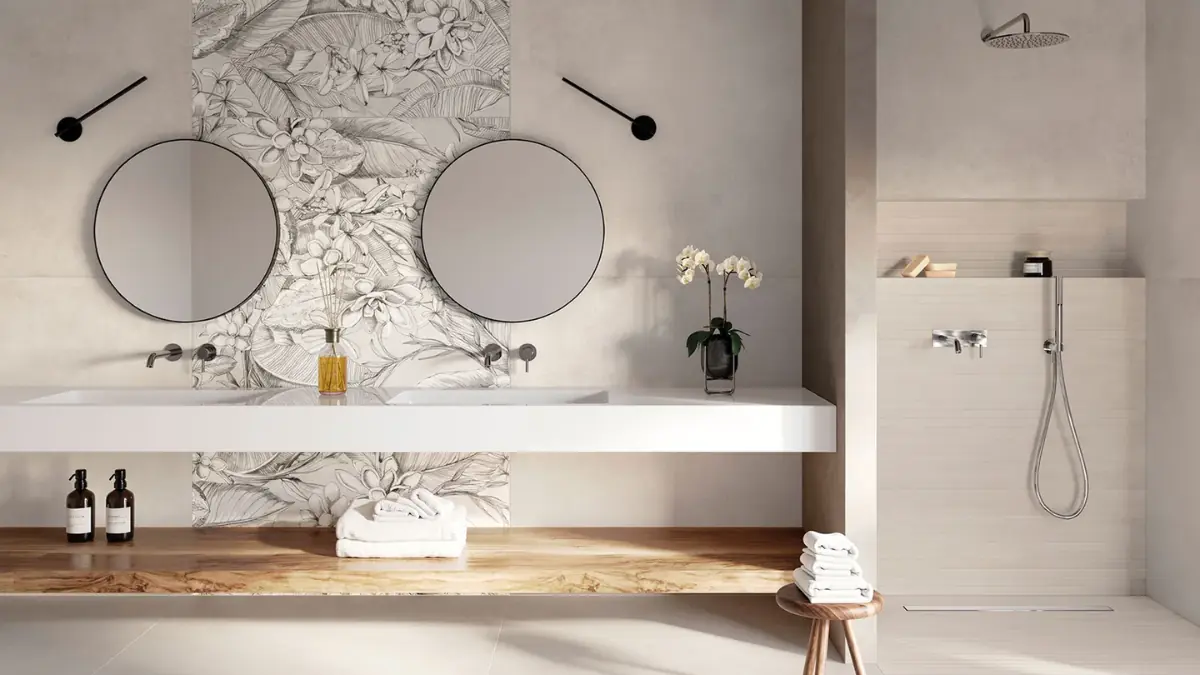
The main difference between porcelain and ceramic tiles is density and water absorption: porcelain absorbs less than 0.5% of water while ceramic typically absorbs more than 0.5% (often 3% or higher), which makes porcelain denser, harder, heavier, more durable and frost-resistant. Porcelain is made from finer clay fired at higher temperatures, while ceramic uses a more porous, softer body. That is why porcelain is the specification-grade choice for floors, bathrooms, wet rooms, high-traffic areas, large-format installations and outdoor use. Ceramic is more porous and softer, but a quality glazed ceramic remains an excellent, easy-to-cut option for low-traffic interior walls and decorative ranges. In short: both are fired clay tiles, but porcelain is the denser, tougher, more water-resistant member of the family, and the safer default wherever performance matters.
That is the honest, direct answer. But knowing why porcelain and ceramic behave so differently, and where each one genuinely belongs, is what separates a confident specification from an expensive guess. In this guide, our design team at Design Di Lusso explains the real technical difference, what the water-absorption standard and PEI ratings actually mean, and how those facts translate into the right tile for your floors, walls, bathroom and beyond.
What is the actual difference between porcelain and ceramic?
Both porcelain and ceramic are made from clay, fired in a kiln and usually finished with a glaze. They belong to the same family, which is exactly why the names get used interchangeably and why the confusion exists. The difference is in the recipe and the firing.
Ceramic tiles are made from a coarser, more natural clay (typically red, brown or white earthenware), fired at lower temperatures, broadly in the 1,000–1,150°C range. The resulting body, the “biscuit”, is softer, more porous and lighter. A glaze is applied on top to give colour, pattern and a water-resistant surface.
Porcelain tiles are made from a finer, more refined clay, usually with a high proportion of white kaolin clay and feldspar, pressed at higher pressure and fired hotter, broadly 1,200–1,400°C. That higher heat vitrifies the clay: the particles fuse into a denser, glass-like body with very little open pore structure. The result is a tile that is harder, heavier, less porous and considerably more durable.
So the headline is simple: porcelain is essentially a denser, more vitrified ceramic. Technically, porcelain is a type of ceramic, but in the tile world the two words describe two distinct performance grades, and the dividing line is measured, not marketing.
What does the water-absorption standard actually mean?
This is the single most important technical fact, and the one most articles skim over. The industry defines porcelain by a measurable water-absorption threshold.
Under the recognised testing standards (ISO 10545-3 internationally, and ASTM C373 in the US), a tile is classed as porcelain only if it absorbs 0.5% or less of its weight in water. Tiles are weighed dry, then boiled or pressure-soaked, then weighed again — the difference is the absorption rate.
- Porcelain: ≤ 0.5% water absorption. Effectively impervious.
- Ceramic: > 0.5%, and commonly 3% or higher. Some wall ceramics absorb 10%+.
That number is not a technicality — it is the property that drives almost everything else. A tile that barely absorbs water resists staining, resists frost (because there is little water inside to freeze and crack it), and copes with constant moisture. A more porous tile is fine on a dry wall but vulnerable on a wet floor, outdoors, or anywhere water can sit. When someone asks for the “real difference,” this 0.5% line is the answer.
Which is more durable, porcelain or ceramic?
Durability is where porcelain pulls clearly ahead, and there are two facts worth understanding.
1. The body is harder all the way through. Because porcelain is denser and fired hotter, it resists chipping, cracking and heavy impact far better than ceramic. Many porcelain tiles are through-body (or “full-body”), meaning the colour runs through the entire tile rather than sitting only in a surface glaze. A chip on a through-body porcelain floor is far less visible because the material underneath matches the surface — a real advantage in high-traffic areas.
2. The surface is graded by PEI. Glazed tiles carry a PEI rating (from the Porcelain Enamel Institute), a 0–5 scale measuring how well the glazed surface resists abrasion and wear from foot traffic:
- PEI 0: walls only, no foot traffic.
- PEI 1: very light traffic, e.g. ensuite walls.
- PEI 2: light traffic, e.g. bathroom floors with soft footwear.
- PEI 3: moderate traffic, suitable for most residential floors.
- PEI 4: heavy traffic, residential plus light commercial.
- PEI 5: very heavy traffic, commercial and public spaces.
As a rule, residential floors want PEI 3 or above, and most quality porcelain floor tiles sit at PEI 4–5. Ceramic can also be rated for floors, but porcelain’s denser body means it generally carries the higher ratings and lasts longer under real-world wear. For porcelain vs ceramic durability, porcelain is the tougher material in body, surface and lifespan.
The head-to-head comparison
| Factor | Porcelain | Ceramic |
|---|---|---|
| Water absorption | ≤ 0.5% (virtually impervious) | > 0.5%, often 3%+ |
| Clay & firing | Refined clay, fired ~1,200–1,400°C | Coarser clay, fired ~1,000–1,150°C |
| Density & hardness | High, dense, vitrified | Lower, softer, more porous |
| Durability (PEI) | Typically PEI 4–5 | Typically PEI 0–3 |
| Floors | Excellent, including high-traffic | Light-traffic floors only |
| Walls | Excellent | Excellent (its natural home) |
| Wet rooms / showers | Excellent (impervious) | Walls yes; floors with care |
| Outdoors | Yes (frost-resistant) | No (not frost-resistant) |
| Frost resistance | Yes | No |
| Ease of cutting / installation | Harder, needs the right tools | Easier to cut and handle |
| Large-format availability | Extensive (rectified, slabs) | Limited |
| Typical use | Floors, wet rooms, large format, outdoors | Decorative walls, low-traffic areas |
Which is better for a bathroom floor?
For a bathroom floor, porcelain is the clear choice. A bathroom floor is the one surface in the room that combines water, foot traffic and the occasional splash that sits before it’s wiped — exactly the conditions porcelain is built for. Its near-zero porosity means moisture doesn’t penetrate, staining is minimal, and the higher PEI rating handles daily use for decades.
There’s a second, often-overlooked reason: slip resistance. Bathroom and wet-room floors should use a tile with an appropriate anti-slip rating (look for R10 or R11, or a measured slip value), and the range of textured, honed and structured porcelain floor tiles designed for exactly this is far wider than in ceramic. You get the safety, the durability and the design choice in one material.
So when the question is porcelain or ceramic for bathroom floor, specify porcelain. Save ceramic for the walls, where its strengths shine and its porosity doesn’t matter.
Can you use ceramic in a wet room?
Yes, but with an important distinction between walls and floors.
On wet-room walls, quality glazed ceramic is perfectly suitable. The glaze provides a water-resistant surface, walls don’t bear foot traffic, and the wall’s job is to shed water rather than withstand standing moisture and abrasion. Many beautiful decorative and patterned ranges are ceramic, and they have a rightful place on a feature wall or in a shower enclosure’s upper walls.
On wet-room floors, porcelain is strongly preferred. A wet-room floor must cope with constant water, gradients to a drain, and slip safety, and porcelain’s impervious, hard-wearing, anti-slip ranges are made for it. Using a more porous ceramic underfoot in a wet room invites moisture issues and faster wear.
The honest summary: ceramic earns its place on the walls; porcelain belongs on the floor. That split is genuinely how our designers specify most wet rooms.
Is porcelain harder to cut and install?
Yes, and this is the one practical area where ceramic has the edge. Because porcelain is denser and harder, it is more demanding to cut and install:
- It needs a quality wet saw with a diamond blade, rather than a basic score-and-snap cutter that handles softer ceramic.
- Intricate cuts, holes for pipework and mitred edges take more skill and time.
- Large-format porcelain slabs require experienced fitters and the right handling equipment.
- A dense, low-absorption body also means the correct adhesive matters — fitters use a suitable flexible or porcelain-rated adhesive for a reliable bond.
Ceramic, by contrast, is softer, lighter and easier to cut, which can make it the sensible choice for very intricate patterns, mosaic-heavy designs or areas with lots of fiddly cuts. None of this is a reason to avoid porcelain — it simply means porcelain rewards proper installation. For premium projects, that skilled fitting is part of the value, and it’s why we always recommend an experienced tiler for porcelain, especially in large format.
What about large-format tiles and slabs?
This is where porcelain stands almost alone. The trend toward large-format tiles and porcelain slabs — dramatic, near-seamless surfaces with minimal grout lines — is essentially a porcelain story, for two reasons.
First, strength. A large, thin tile needs a dense, stable body to travel, handle and fit without cracking. Porcelain’s vitrified structure makes large formats possible; ceramic’s softer body generally cannot span those sizes reliably.
Second, rectified edges. Premium large-format porcelain is usually rectified, meaning each tile is mechanically ground to a precise, uniform size with crisp 90° edges. Rectified tiles can be laid with very thin grout joints, which is what creates that continuous, luxurious, slab-like look. Rectified ceramic exists but is far less common, and the size range is limited.
If you’re drawn to the contemporary, minimal-grout aesthetic — on floors, feature walls, shower panels or even worktops — you’re almost certainly looking at porcelain.
Can you use either one outdoors?
For outdoor use, only porcelain is suitable. This comes straight back to the water-absorption fact. Outdoors, tiles face rain, and in a British winter, freezing temperatures. Water absorbed into a porous tile expands as it freezes, and over repeated cycles that cracks and spalls the tile — a process called frost damage.
Because porcelain absorbs ≤ 0.5% water, there is almost no moisture inside to freeze, so quality porcelain is frost-resistant and rated for external paving, patios and indoor-outdoor schemes (often as 20mm structural porcelain). Standard ceramic is not frost-resistant and should never be used outdoors in a climate that freezes. If your project flows from an interior floor out to a terrace, porcelain lets you run the same look seamlessly inside and out; ceramic cannot.
Can you tell porcelain and ceramic apart by looking?
Not reliably by sight alone, which is part of why the labels matter. A glazed ceramic and a glazed porcelain can look identical on the showroom wall. There are, however, a few honest tells:
- The unglazed edge or back. Porcelain’s body is usually a consistent, fine, often white or grey colour through the cross-section (especially through-body porcelain). Many ceramics show a reddish, tan or white earthenware “biscuit” beneath the glaze.
- Weight. Picked up side by side, porcelain feels denser and heavier for its size.
- The label. The most reliable method — the technical data sheet states the water-absorption group and whether the tile meets the porcelain standard.
For a buyer, the practical takeaway is to specify by performance, not appearance, and rely on the data sheet — which is exactly the kind of detail our showroom team checks for you.
Which should you choose? An honest verdict
Choose porcelain when the surface has to perform: any floor, especially high-traffic; any bathroom or wet-room floor; large-format and slab installations; outdoors and indoor-outdoor schemes; anywhere you want frost resistance, maximum durability and the lowest maintenance. For premium, specification-grade projects, porcelain is the default, and it’s our specialism for exactly that reason.
Quality ceramic is the sensible choice when the surface is a low-traffic interior wall, when you’ve fallen for a beautiful decorative or hand-finished ceramic range, when a design needs lots of intricate cuts or mosaics where easier cutting helps, or in dry rooms where porcelain’s extra performance simply isn’t needed. A well-made glazed ceramic on a feature wall is not a compromise — it’s the right tool for that job.
| Location | Best choice | Why |
|---|---|---|
| Bathroom / wet-room floor | Porcelain | Impervious, durable, anti-slip ranges |
| Bathroom / shower walls | Ceramic or porcelain | Glaze handles wall moisture; choose for look |
| Living / kitchen / hall floor | Porcelain | High-traffic durability, PEI 4–5 |
| Decorative feature wall | Ceramic or porcelain | Wide decorative ranges in both |
| Large-format / minimal-grout look | Porcelain | Strength + rectified edges |
| Outdoor patio / indoor-outdoor flow | Porcelain | Frost-resistant, structural ranges |
| Low-traffic interior wall | Ceramic | Easy to fit, no performance demand |
Does porcelain cost more than ceramic?
Generally, yes — porcelain sits in a higher bracket than equivalent ceramic, because the refined materials, higher firing temperatures and denser manufacturing cost more, and porcelain’s installation is more involved. But the framing matters: porcelain’s durability, water resistance and lifespan mean it’s typically the better long-term investment for any surface that has to perform — you’re paying for a material that won’t need replacing or fussy upkeep.
Pricing varies widely by range, size, finish and origin, with large-format, rectified and book-matched ranges at the premium end. The right question is rarely “which is less expensive?” but “which material is right for this surface?” — and on a floor or in a wet room, that answer is almost always porcelain.
A quick best-practice checklist before you buy
- Specify by performance, not just looks: confirm the tile meets the porcelain standard (≤ 0.5% absorption) where it matters.
- Check the PEI rating for floors: aim for PEI 3+ residential, PEI 4–5 for high-traffic.
- Match the tile to the surface: porcelain for floors, wet-room floors, large format and outdoors; ceramic is fine for low-traffic walls.
- Mind slip resistance on bathroom and wet-room floors (look for R10/R11 or a measured slip value).
- Choose rectified, large-format porcelain for the seamless, minimal-grout look.
- Use an experienced tiler for porcelain, especially in large format, with the correct diamond tooling and adhesive.
- Read the data sheet, not just the display — porcelain and ceramic can look identical on the wall.
Frequently asked questions
Are porcelain tiles better than ceramic?
For performance, yes — porcelain is denser, harder, more water-resistant and more durable, making it better for floors, wet rooms, high-traffic areas and outdoors. But “better” depends on the job: quality ceramic is an excellent, easier-to-fit choice for low-traffic interior walls and decorative ranges, where porcelain’s extra performance isn’t needed.
What is the real difference between porcelain and ceramic tiles?
The defining difference is water absorption. Porcelain absorbs 0.5% or less of its weight in water (per ISO 10545-3 / ASTM C373), while ceramic absorbs more, often 3% or higher. Porcelain uses finer clay fired at higher temperatures, giving a denser, harder, frost-resistant body. Ceramic is softer, more porous and lighter.
Which is better for a bathroom floor, porcelain or ceramic?
Porcelain is better for a bathroom floor. Its near-zero water absorption resists moisture and staining, its higher PEI rating handles foot traffic, and a wide range of anti-slip porcelain floor tiles offers proper slip safety. Ceramic is best kept to the walls, where its porosity doesn’t matter and its glaze sheds water well.
Can you tell porcelain and ceramic apart?
Not reliably by appearance — glazed versions can look identical. The honest tells are the cross-section (porcelain’s body is usually consistent and fine; ceramic often shows a reddish or tan biscuit), the weight (porcelain feels denser), and most reliably the technical data sheet, which states the water-absorption group and whether the tile meets the porcelain standard.
Is porcelain harder to cut and install?
Yes. Because porcelain is denser and harder, it needs a wet saw with a diamond blade rather than a basic score-and-snap cutter, and intricate cuts and large formats take more skill. Ceramic is softer, lighter and easier to cut, which can help with very intricate designs. Porcelain rewards an experienced tiler, especially in large format.
Can you use ceramic tiles outdoors?
No. Standard ceramic is not frost-resistant: absorbed water freezes, expands and cracks the tile over winter cycles. Only porcelain, which absorbs 0.5% or less water, is frost-resistant and suitable for outdoor patios, paving and indoor-outdoor schemes, often as 20mm structural porcelain.
Are porcelain tiles worth the extra cost?
For any surface that has to perform — floors, wet rooms, high-traffic areas, large format and outdoors — yes. Porcelain’s durability, water resistance and lifespan make it the better long-term investment, with lower maintenance and less risk of replacement. For a low-traffic, dry interior wall, a quality ceramic can be the sensible, equally beautiful choice.
Which is better, porcelain or ceramic, for a high-traffic floor?
Porcelain. High-traffic floors need a hard, abrasion-resistant surface, and porcelain typically carries PEI 4–5 ratings with a dense, often through-body construction that hides wear and chips. Ceramic floor tiles exist but generally sit at lower PEI ratings and wear faster under heavy daily use.
See the difference in person at our Watford showroom
Porcelain and ceramic can look near-identical in a photograph or even on a showroom wall, yet they perform completely differently underfoot, in a wet room, or laid as a large-format floor. The weight, the edge, the finish, the way a rectified porcelain reads as a near-seamless surface — these reveal themselves only in person. Visit our 7,000 sq ft showroom in Watford to handle our porcelain and ceramic collections side by side, compare large-format and rectified ranges, and talk through the right tile for every surface with our award-winning team. Whether you’re a homeowner planning a bathroom or a designer specifying floors and walls for a client, we’ll help you choose with confidence.