
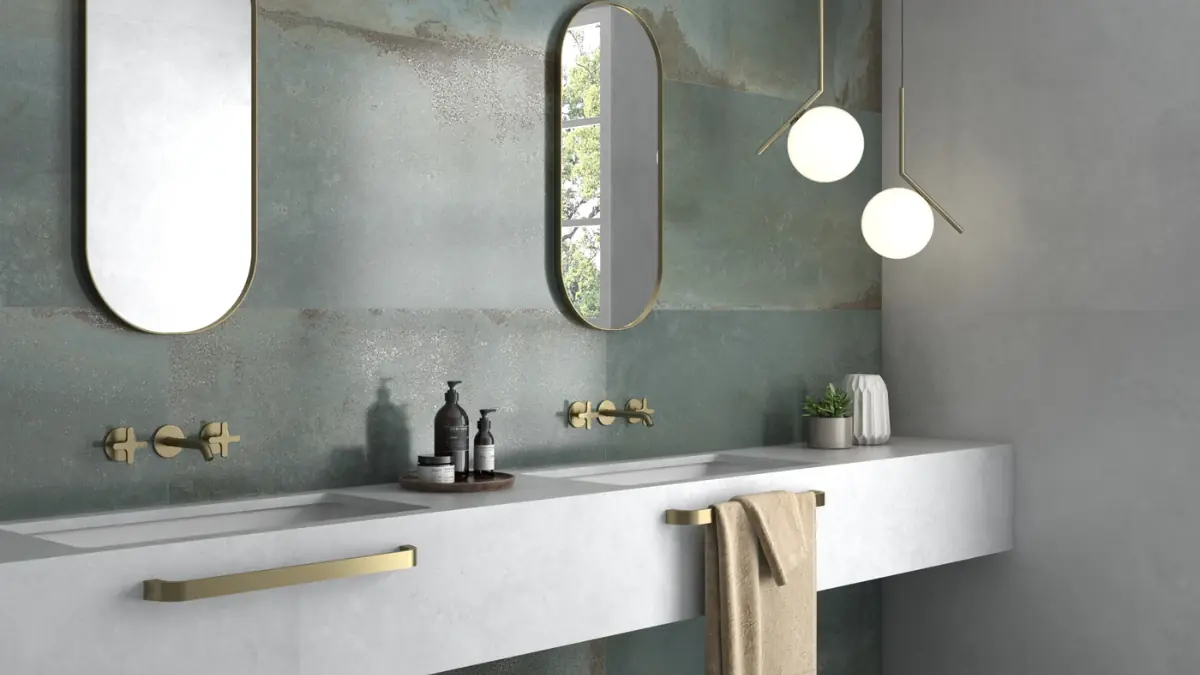
Yes, large format tiles are worth it for a luxury finish: with fewer grout lines they create a seamless, more spacious and easier-to-clean look, but they cost more in materials and installation, need a perfectly flat substrate and specialist fitting. For most premium bathrooms and kitchens, that investment is justified by a calm, high-end result you simply cannot achieve with standard tiles. Large format porcelain (typically 600×600mm and above, up to 1200×1200mm) and porcelain slabs (up to 1600×3200mm) reduce visual clutter, suit book-matched feature walls, and make small rooms feel larger. The trade-offs are real: heavier handling, harder cutting, the need for a flat, well-prepared substrate and skilled installation. Specified and fitted properly, large format tiles are one of the highest-impact upgrades in modern interior design.
That is the honest, direct answer. But “are they worth it for your project?” deserves a proper conversation, because large format is one of the few decisions that transforms how a finished room reads, and it has genuine practical realities most articles skip over. In this guide, our design team at Design Di Lusso explains exactly what counts as large format, why designers love it, where it works (including small bathrooms), what the real downsides are, what it costs in the UK premium bracket, and how to decide whether it’s right for you.
What counts as a large format tile?
There’s no single legal definition, but in the trade large format generally means any tile with a face of 600×600mm or larger, or any tile with one edge longer than 600mm. In practice, the category spans a wide range, and the experience of each size is quite different.
- 600×600mm is the entry point to large format, popular and versatile.
- 600×1200mm is the current designer favourite, especially on walls.
- 1200×1200mm delivers a genuinely expansive, minimal-grout look.
- Porcelain slabs go far bigger, up to 1600×3200mm and around 6mm thick, used for near-seamless walls, floors, vanity tops and even shower trays.
The bigger the tile, the fewer the joints, and the more seamless and luxurious the surface reads. That single idea — fewer grout lines — is the thread running through almost every benefit of large format, and the reason the look has dominated high-end interiors for the last decade.
A quick large format size guide
Each format has a sweet spot. Here’s how our designers match size to use.
| Size | Look | Best use | Install difficulty |
|---|---|---|---|
| 600×600mm | Clean, classic large format | Floors, walls, smaller rooms | Moderate |
| 600×1200mm | Sleek, contemporary, fewer joints | Bathroom and kitchen walls, floors | Moderate–high |
| 1200×1200mm | Expansive, minimal grout | Open-plan floors, large walls | High |
| Porcelain slabs (up to 1600×3200mm) | Near-seamless, book-matched | Feature walls, vanity tops, wet rooms, splashbacks | Specialist |
As the format grows, the look becomes more seamless and luxurious, but handling, cutting and installation all become more demanding — increasingly a job for specialists rather than a DIY weekend.
Why do designers love fewer grout lines?
Grout lines are the visual “noise” of a tiled surface. Reduce them, and several things happen at once.
The room reads as one continuous surface. Instead of a busy grid, the eye sees a calm, uninterrupted plane. This is the single biggest reason large format feels expensive: it removes clutter and lets the material — especially marble-effect veining — speak for itself.
Small rooms look bigger. Fewer joints means fewer visual “stops” for the eye, so the surface appears to stretch further. Counter-intuitively, larger tiles often make compact bathrooms feel more spacious, not less.
Cleaning is genuinely easier. Grout is the part of any tiled surface that attracts dirt, staining and mould. Fewer grout lines means less grout to scrub, seal and maintain — a real, practical, everyday benefit, not just an aesthetic one.
It enables the seamless and book-matched trend. Porcelain slabs can be book-matched, where two slabs mirror each other along the veining, creating a dramatic, symmetrical pattern that flows across a feature wall like a single piece of stone. This is one of the most requested looks in luxury bathroom design, and it’s only possible at large format and slab scale.
Hygiene. Because premium large format porcelain is virtually non-porous and has minimal joints, the surface is more hygienic and resists water — ideal for wet rooms, showers and splashbacks.
Do large format tiles work in a small bathroom?
This is the most common worry, and the answer surprises people: yes, large format tiles usually make a small bathroom look bigger, not smaller.
The instinct is that big tiles will “overwhelm” a small room. In reality, the opposite is true. A small bathroom tiled in lots of small tiles is covered in grout lines — a dense grid that breaks the space into many little pieces and emphasises how compact it is. Swap to large format, and those joints largely disappear. The walls and floor read as continuous surfaces, the eye travels uninterrupted, and the room feels calmer and more expansive.
A few practical tips from our designers for small spaces:
- Run the same tile up the walls and across the floor for a seamless, space-stretching effect.
- Choose 600×600mm or 600×1200mm rather than the very largest slabs, which can be awkward to cut around fixtures in a tight room.
- Match the grout colour to the tile so the few remaining joints all but vanish.
- Use rectified tiles (precision-cut edges) to achieve the thinnest possible grout lines.
Used this way, large format is one of the most effective tools for making a compact ensuite or cloakroom feel like a calm, high-end retreat. Pair it with a single marble-effect feature and considered lighting and a small room punches well above its size.
What are the real downsides?
Honesty matters more than hype, so here are the genuine trade-offs, plainly stated.
Higher material cost. Large format porcelain and especially porcelain slabs sit firmly in the premium bracket. You’re paying for the manufacturing precision, the rectified edges and the format itself.
Higher installation cost. This is the part people underestimate. Large format is slower and more skilled to fit than standard tiling, and it needs the right tools and crew.
It needs a perfectly flat substrate. Big, rigid tiles cannot follow an uneven wall or floor — any dip or hump shows up as “lippage” (one tile edge sitting proud of its neighbour). Surfaces typically need to be flat to within roughly 3mm over 2 metres, which often means levelling, skimming or backerboarding before tiling begins.
Specialist handling. A single large slab is heavy and can crack if mishandled. Larger formats genuinely require two people to lift and place, sometimes with suction-cup handling frames.
Harder to cut. Cutting and drilling large porcelain (for pipes, sockets and corners) demands proper rail cutters, wet saws and skill. There’s less margin for error than with small tiles.
Specialist fitting techniques. A quality large format installation uses back-buttering (applying adhesive to the back of the tile as well as the substrate to ensure full contact), levelling clips/systems to keep adjacent edges flush, and careful adhesive coverage to avoid voids. This is not a DIY-friendly job — it’s a job for an experienced fitter.
Less DIY-friendly overall. Standard tiles forgive a beginner; large format does not. For most homeowners, large format means budgeting for professional installation, which is part of the true cost.
Pros vs cons at a glance
| Pros | Cons / realities |
|---|---|
| Fewer grout lines, seamless luxury look | Higher material cost |
| Makes small rooms look bigger | Higher, specialist installation cost |
| Easier to clean (less grout) | Needs a perfectly flat substrate |
| More hygienic, virtually non-porous porcelain | Heavy, needs two-person handling |
| Enables book-matched, slab and feature looks | Harder to cut and drill |
| On-trend, high-end finish | Not DIY-friendly |
| Durable, hard-wearing porcelain | Less forgiving of installer error |
The pattern is clear: almost every benefit is about the finished look and the lifetime of low-maintenance use; almost every downside is about the upfront cost and the skill required to fit it. That’s the trade at the heart of the “is it worth it?” question.
What do large format tiles cost?
Pricing varies enormously by range, finish, format and the surface you’re tiling, so we won’t quote fixed figures as fact — your project deserves accurate, specific numbers. But here’s the honest cost picture in the UK premium bracket.
Material. Large format porcelain sits above standard tiles per square metre, and porcelain slabs sit higher again, reflecting their size, precision and the look they deliver. Marble-effect and book-matched ranges command a premium for their design impact.
Installation. This is where the real difference lies. Expect to pay more per square metre to fit large format than standard tiles, because it’s slower, more skilled, often needs two fitters, and requires the right cutting and levelling equipment.
Substrate preparation. Factor in the cost of getting walls and floors flat enough — levelling compound, backerboard or skimming. Skipping this is a false economy that shows up as lippage and cracked tiles.
The right way to think about it: large format is an investment in a seamless, premium, low-maintenance finish that lasts for decades. When you account for the calmer look, the easier cleaning and the way porcelain shrugs off water and wear, the value over the life of the room is genuinely strong. Our design team can give you accurate, project-specific pricing once we understand your areas, ranges and substrate.
Where do large format tiles work best?
Large format earns its keep almost anywhere a calm, continuous, premium surface elevates the room:
- Bathroom and shower walls. Fewer joints, more hygienic, and a spa-like seamlessness. Slabs are ideal for walk-in showers and wet rooms.
- Open-plan floors. 1200×1200mm and large slabs make expansive floors read as one uninterrupted surface.
- Kitchen splashbacks and worktops. Porcelain slabs deliver a near-seamless, heat- and stain-resistant run with minimal joints.
- Vanity tops and feature walls. Book-matched slabs create a showstopping, single-piece-of-stone effect.
- Small bathrooms and cloakrooms. Large format makes compact rooms feel bigger, not smaller.
- Outdoor and indoor-outdoor flow. Many ranges offer a matching 20mm paver for patios and terraces, so you can run the same look seamlessly from inside to out — a signature of high-end design.
Are large format tiles worth it for you?
Large format is worth it if you want a seamless, luxurious, modern finish; you value easier cleaning and a more hygienic surface; you’re working with (or willing to prepare) a flat substrate; and you’ll have it professionally fitted. For premium bathrooms, kitchens and open-plan spaces, it’s one of the highest-impact upgrades available, and the look is simply not achievable with standard tiles.
Large format needs more thought if you’re planning a DIY install, your walls or floors are significantly uneven and you don’t want to prepare them, or the room has many tight cuts around awkward fixtures. None of these rule it out, but they affect the cost and the fitter you’ll need.
For the overwhelming majority of premium projects, the answer is yes, it’s worth it, provided it’s specified and fitted properly. The seamless result, the spacious feel, the low-maintenance porcelain and the on-trend, high-end look repay the investment every single day you use the room. The key, as with all luxury finishes, is doing it right: the correct format for the space, a properly prepared substrate, rectified edges, tonal grout and a skilled installer.
A buyer’s checklist before you commit
Before specifying large format, run through these with your designer:
- Right format for the room? 600×600mm or 600×1200mm for compact spaces; 1200×1200mm and slabs for larger, statement areas.
- Is the substrate flat enough? Plan (and budget) for levelling if needed.
- Rectified edges? Choose rectified tiles for the thinnest, most seamless grout lines.
- Tonal grout? Match grout to tile so the few remaining joints disappear.
- Professional installer lined up? Large format is a specialist fit — confirm experience and the right equipment.
- Seen it in person? Large format and slabs have an impact and a scale you can only judge in a showroom.
- Want book-matching or indoor-outdoor flow? Decide early — it affects the range and the slab layout.
Large format in different styles
Large format adapts to almost any luxury aesthetic — the surrounding scheme sets the tone:
- Contemporary minimal. Large-format matt porcelain in a soft neutral, run floor-to-ceiling with tonal grout and handleless joinery, creates a serene, gallery-like calm where the seamlessness is the statement.
- Classic and opulent. Book-matched marble-effect slabs on a feature wall, framed by polished surfaces and brushed brass, deliver hotel-suite grandeur — the slab’s symmetry doing the dramatic work.
- Industrial and natural. Large-format concrete- or stone-effect porcelain brings warmth and texture across expansive floors without the busy joints of smaller tiles.
- Indoor-outdoor luxury. A large-format floor that flows out to a matching 20mm paver on the terrace blurs the line between inside and out — a hallmark of considered, high-end design.
Large format isn’t tied to one look. Choose the right format, finish and grout, and it elevates almost any premium scheme.
Frequently asked questions
Are large format tiles worth the extra cost?
For a premium, seamless finish, yes. Large format tiles cost more in materials and skilled installation, but they deliver fewer grout lines, an easier-to-clean and more hygienic surface, and a high-end look that standard tiles can’t match. Properly specified and fitted, the investment is justified by the result and the low-maintenance years that follow.
Do large format tiles make a small room look bigger?
Yes. By dramatically reducing grout lines, large format tiles remove the busy grid that makes a small room feel cramped. The surfaces read as continuous planes, so the eye travels uninterrupted and the space feels calmer and larger — especially with tile-matched grout and rectified edges.
Are large format tiles harder to install?
Yes. Large format tiles are heavier, need two-person handling, require a flat substrate (typically within around 3mm over 2m), and use techniques like back-buttering and levelling clips to avoid lippage. Cutting large porcelain also needs proper equipment. They’re a specialist, not a DIY, job.
What is the largest tile size available?
Porcelain slabs are the largest format, reaching up to 1600×3200mm and around 6mm thick. They’re used for near-seamless feature walls, floors, vanity tops, splashbacks and even shower trays, and can be book-matched for a dramatic, single-piece-of-stone effect.
Do large format tiles have fewer grout lines and less cleaning?
Yes. The larger the tile, the fewer the joints. Since grout is the part of any tiled surface that attracts dirt, staining and mould, fewer grout lines means a more hygienic, easier-to-clean surface with less grout to scrub, seal and maintain over time.
What is large format porcelain, exactly?
Large format porcelain is a high-quality, virtually non-porous porcelain tile produced in faces of 600×600mm and above, up to 1200×1200mm, with porcelain slabs larger still. It’s hard-wearing, water-resistant and ideal for bathrooms, kitchens and floors, combining a seamless look with excellent durability.
Can large format tiles be used on walls and floors?
Yes. Large format tiles work on both, and running the same tile up the walls and across the floor creates a seamless, space-stretching effect. Heavier slabs on walls need correct adhesive, coverage and fixing — another reason professional installation matters.
Do large format tiles need a special substrate?
They need a flat, stable, well-prepared substrate, typically flat to within around 3mm over 2 metres. Uneven surfaces cause lippage and can crack rigid tiles, so levelling, skimming or backerboarding is often part of the job and should be factored into the project budget.
Why see large format and slabs in person
Large format tiles, and porcelain slabs especially, are very hard to judge from a photograph. Their scale, the seamlessness, the way a book-matched slab flows, and the realism of premium marble-effect ranges only reveal themselves at full size, under proper light, in front of you. Two ranges that look similar online can feel completely different in person once you see the format, the finish and the veining at scale. Seeing them in a showroom is the difference between a confident decision and an expensive guess.
Visit our 7,000 sq ft showroom in Watford to see our large format porcelain and slab collections at full size, under proper lighting, and to talk through your bathroom or kitchen design with our award-winning team. Whether you’re a homeowner planning a seamless ensuite or a designer specifying slabs for a client, we’ll help you get the format, substrate and finish right.