
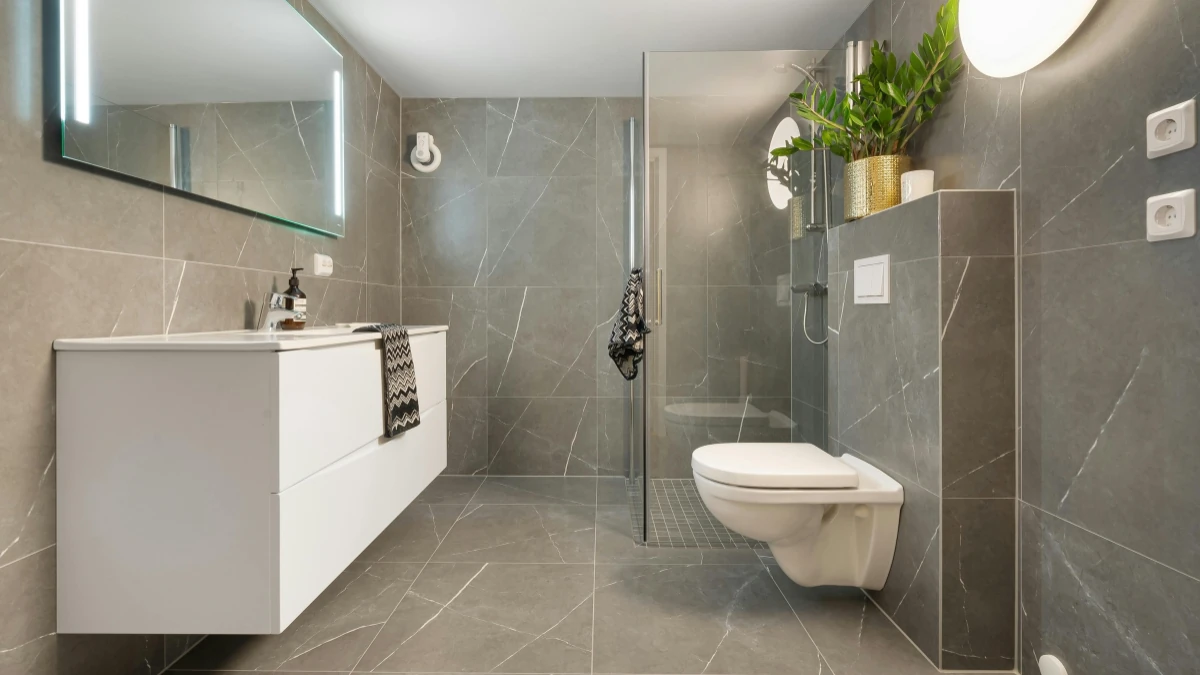
The best wet room tiles are large-format porcelain in a slip-resistant finish: choose a textured floor tile rated R10–R11 for grip underfoot, paired with a polished or matt version of the same marble- or stone-effect tile on the walls, so the scheme flows seamlessly from floor to wall with minimal grout lines. This combination gives a luxurious, low-maintenance, virtually waterproof wet room that stays safe underfoot, because large-format porcelain minimises the grout joints where water and grime collect, while a single cohesive colour story makes the space feel calm and considered. Below are the wet room tile ideas, layouts and practical rules our designers use to create wet rooms that look stunning and perform for decades.
A wet room is the most luxurious thing you can do with a bathroom, an open, spa-like space with no shower tray or enclosure, where water drains directly through a tiled, gently sloping floor. It’s also the least forgiving room in the house if the tiles are chosen badly, because here tiles aren’t just decoration: they’re the waterproofing, the safety surface and the entire aesthetic, all at once. This guide brings together the design ideas and the practical know-how to get both right.
What makes a wet room different (and why tile choice is critical)
In a standard bathroom, tiles sit on top of the structure. In a wet room, the tanked (fully waterproofed) floor and walls, finished in tile, are the system. The floor slopes subtly toward a drain, water runs across the tile, and the whole zone has to stay watertight, safe underfoot and beautiful, every day, for years.
That raises the stakes on three decisions: the finish (for slip resistance), the format and layout (for the look and for proper drainage falls), and the material (for water resistance and durability). Get those right and a wet room is pure luxury. Get them wrong and you have a slippery, grout-stained, leak-prone problem. Let us take them in turn, with the ideas that make a wet room feel special.
Idea 1: Use large-format tiles for a seamless, luxurious feel
The single biggest “luxury lever” in a wet room is reducing grout lines. Fewer joints means a calmer, more expensive-looking space, and far less grout to clean and maintain (grout is where wet rooms tend to look tired over time).
Large-format porcelain (600×1200mm and larger, up to full slabs) is how you achieve that seamless effect. On the walls, go as large as the space and your fitter allow. On the floor, you’ll typically use a slightly smaller format or a tile that can accommodate the necessary falls toward the drain — your installer will advise, because very large floor tiles can complicate drainage gradients.
The contemporary, high-end wet room look is essentially: big, calm expanses of beautiful tile, minimal grout, one or two considered feature moments. Large format is the foundation of that.
Idea 2: Get the finish right for safety (this is non-negotiable)
A wet room floor is wet by design, so slip resistance is not optional. Look for floor tiles with an appropriate anti-slip rating, commonly R10 to R11 for wet areas, or a measured pendulum (PTV) value suited to wet barefoot use. Our designers typically specify:
- Textured stone-effect or matt porcelain on the floor. These give natural grip and look beautifully organic.
- Polished or satin finishes reserved for the walls, where slip isn’t a concern and you can enjoy a little more sheen and glamour.
A favourite designer trick: a matt floor tile paired with a polished wall tile in the same colour family. You get safety underfoot and a touch of glamour at eye level, all within one cohesive look. You never have to choose between safe and beautiful.
Idea 3: Wrap one material floor-to-ceiling for drama
Running the same tile, or the same tile family, across the floor and up the walls makes a small wet room feel larger and intentionally designed. It removes visual interruptions, so the eye travels uninterrupted and the space feels calm and expansive. Marble-effect and stone-effect porcelain both do this beautifully.
Then add one contrasting feature for a focal point: an onyx-effect niche, a band of herringbone mosaic, or a single accent wall in a richer tone. The formula is “calm base + one hero detail” — it reads as designed, not busy.
Idea 4: Choose a colour scheme that suits the mood
Colour sets the entire atmosphere of a wet room. Here are the schemes we use most, and who they suit:
| Look | Palette | Best for |
|---|---|---|
| Spa-calm | Soft stone, beige, warm grey | A relaxing, timeless retreat |
| Modern monochrome | Charcoal + crisp white | Sharp, contemporary homes |
| Natural luxe | Travertine + warm wood-effect | Organic, inviting, biophilic schemes |
| Statement | Green or onyx feature wall + neutral base | Bold, memorable design |
| Hotel luxury | Large-format marble-effect throughout | Five-star, seamless glamour |
For most homeowners, a warm neutral base (stone or soft marble-effect) with a single accent is the safest route to a wet room that feels luxurious now and still looks right in ten years.
Idea 5: Think about tile size and the small-wet-room myth
There’s a persistent myth that small rooms need small tiles. The opposite is usually true. Large tiles make a small wet room feel bigger because they reduce the number of grout lines that visually “chop up” the space. In a compact wet room, large-format porcelain on the walls, with a sensibly sized, textured floor tile, almost always looks more spacious and more expensive than lots of little tiles.
Save small-format and mosaic tiles for deliberate accents: the shower niche, a feature band, or a textured floor zone where extra grip is welcome.
Idea 6: Don’t forget the details that signal quality
The difference between a good wet room and a genuinely luxurious one is in the details:
- Tile the shower niche in a contrasting feature tile — a small spend with a big visual payoff.
- Match or conceal the drain. Choose a tileable (hidden) drain cover or a slot drain that disappears into the floor tile for a near-invisible, high-end finish.
- Continue tiles into niches and across thresholds. Breaks and changes of material cheapen the look. Continuity reads as luxury.
- Add underfloor heating under the porcelain — warm tiles underfoot in an open wet room is one of the most genuinely luxurious upgrades you can make, and it also helps the floor dry faster, reducing slip risk and limescale.
- Choose grout deliberately. A tone matched closely to the tile (never bright white on a coloured tile) for the most seamless, premium result — and use a quality grout suited to wet environments.
Idea 7: Coordinate tiles with brassware and glass
A wet room often includes a single glass splash panel and exposed brassware. Tie these to your tiles: brushed brass and gold sing against green, honey and warm stone tones; matt black and chrome suit monochrome and cool marble schemes. A frameless glass panel keeps the open, seamless feeling intact while protecting the rest of the room from spray.
The practical rules designers never break
- Waterproofing (tanking) comes first. No tile, however good, fixes a poorly tanked wet room. This is a job for a skilled installer, and worth every penny.
- Get the falls right. The floor must slope correctly toward the drain. This is where tile size and installer skill matter — discuss it before choosing your floor tile.
- Slip resistance on the floor is mandatory. Always specify an appropriate anti-slip rating for barefoot wet use.
- Sample in situ, under your own lighting. Tile colour and finish shift dramatically between a showroom and your bathroom’s real light. Always view large samples in the actual space before committing.
- Buy enough tile in one batch. Shade can vary slightly between production batches — ordering your full quantity (plus cuts/spares) together avoids mismatches.
How much does a tiled wet room cost?
A wet room is a premium project, and tiles are only one part — tanking, drainage, glass, brassware and skilled installation all contribute. The tile itself spans a wide range depending on format and quality: large-format luxury porcelain costs more per square metre than basic tiles, but the difference in the finished look is significant, and porcelain’s durability means you’re unlikely to retile for many years. Because wet rooms reward quality (this is not the room to cut corners), our advice is to invest in the tiles and the installation, and economise elsewhere if you must. Our design team can help you plan a wet room that hits your budget without compromising on the things that matter most.
Tile layouts that work in a wet room
Layout is an underrated part of a wet room’s success. A few principles our designers apply:
- Run wall tiles in a clean straight stack for a calm, contemporary, hotel-like feel — this lets large-format tiles read as big, uninterrupted planes.
- Lay floor tiles to suit the falls. Because the floor slopes to the drain, your fitter will plan the layout around the gradient. Smaller floor formats or a central linear drain can make the falls easier to achieve neatly.
- Align floor and wall grout lines where possible — when the joints line up, the room feels considered and seamless rather than accidental.
- Centre the feature. If you have a feature wall or niche, position it where it’s seen on entry or from the bath, so it does its job as a focal point.
- Plan cuts at the edges, not the centre. A skilled fitter arranges the layout so that full tiles fall in the most visible areas and cuts are tucked into corners.
Wet room lighting: the finishing layer
Lighting transforms how tiles look in a wet room, and because the space is often enclosed and used morning and night, it matters more than in a standard bathroom. Layer your lighting:
- Recessed downlights rated for wet/zone use for general light.
- A waterproof feature light or grazing LED to highlight a feature wall or onyx-effect panel — this is where a wet room gains real drama.
- Warm colour temperature (around 2700–3000K) flatters natural stone and marble-effect tones and creates a spa-like atmosphere; cooler light reads more clinical.
- Mirror and niche lighting to add depth and a sense of luxury.
Well-lit tiles look richer, more textured and more expensive. Poorly lit, even the best tiles fall flat. Design the lighting alongside the tiles, not as an afterthought.
How to maintain a wet room so it stays beautiful
One of the biggest advantages of choosing porcelain is how little maintenance it needs, but a few habits keep a wet room looking its best for years:
- Squeegee or wipe down the walls and glass after use to minimise limescale and water spotting (especially in hard-water areas like much of Hertfordshire).
- Clean with pH-neutral products. Avoid harsh acidic or abrasive cleaners that can dull finishes and damage grout.
- Keep grout healthy. Quality grout in a tone matched to the tile not only looks better but ages better. Re-seal grout lines periodically if your installer recommends it.
- Ventilate well. Good extraction reduces moisture build-up, mould risk and limescale, protecting both the tiles and the room.
- Address any sealant or silicone around edges and the glass promptly if it shows wear, to protect the waterproofing.
Porcelain, marble-effect and stone-effect tiles don’t need sealing the way natural stone does — a major practical reason we recommend them for wet rooms.
Common wet room mistakes to avoid
Honesty is more useful than a sales pitch, so here are the errors we most often help clients avoid:
- Choosing a slippery floor tile because it looked good in the showroom — always check the anti-slip rating for the floor.
- Skimping on tanking or installation. The most beautiful tiles can’t rescue a poorly waterproofed wet room. Invest here.
- Using lots of small tiles because you think they suit a small room. They usually make the space feel busier and increase grout maintenance.
- Bright white grout on a coloured or marble tile. It cheapens the look and shows dirt. Match the grout tone.
- Forgetting the falls. Incorrect floor gradients mean standing water — this is a design-and-installation issue to settle before tiling.
- Over-featuring. Too many bold elements compete. One hero, calm surroundings.
- Not buying enough tile in one batch. Shade variation between batches can spoil a seamless look.
Bringing it together: a designer’s ideal wet room
If we were specifying a luxury wet room today, it would look something like this: large-format marble-effect or stone-effect porcelain wrapping floor to ceiling; a textured matt version of the tile on the floor for grip; a single backlit onyx-effect or feature wall as the hero; a hidden slot drain; underfloor heating throughout; a frameless glass panel; warm layered lighting; and brassware chosen to complement the tile’s tone. Calm, seamless, safe and unmistakably luxurious — and built to look that way for decades.
Frequently asked questions
What are the best tiles for a wet room floor?
Textured or matt porcelain with an anti-slip rating of around R10–R11 for safe barefoot use. Pair a grippy floor tile with large-format wall tiles for a look that’s both safe and luxurious.
Can you use the same tiles on wet room walls and floor?
Yes, and it’s a designer favourite for a seamless, spacious look. Use a slip-resistant (matt or textured) finish on the floor, and you can use a polished version of the same tile on the walls for a touch of glamour.
Do wet room tiles need to be non-slip?
Floor tiles must be slip-resistant for safety, since the floor is wet by design. Wall tiles don’t need to be, so you can use glossier, more decorative finishes at eye level.
Are large tiles good for a small wet room?
Yes. Large-format tiles reduce grout lines and make a small wet room feel bigger and more luxurious — the idea that small rooms need small tiles is outdated.
What is the best colour for a wet room?
Warm neutrals (soft stone, beige, warm grey) create a timeless, spa-like feel and are the safest long-term choice. Add a single accent — a green or onyx feature wall — if you want more drama.
Is porcelain or natural stone better for a wet room?
Porcelain (including stone- and marble-effect porcelain) is usually the better choice: it’s virtually non-porous, highly durable and low-maintenance, whereas natural stone is porous and needs sealing and careful upkeep in a wet environment.
Should I have underfloor heating in a wet room?
We highly recommend it. Warm tiles underfoot are a genuine luxury, and underfloor heating helps the floor dry faster, which reduces slip risk and limescale build-up.
Wet room tile ideas for different spaces
Wet rooms come in many forms, and the best tile approach varies with the space:
- The luxury master wet room. Go all-in on the seamless look: large-format marble-effect porcelain floor-to-ceiling, a feature wall behind the bath or in the shower zone, underfloor heating throughout, and a hidden drain. This is the five-star sanctuary.
- The compact ensuite wet room. Keep it calm and continuous — one tile family across all surfaces makes a small space feel bigger. A single slim feature (a niche or narrow band) adds interest without crowding. Avoid busy patterns here.
- The family wet room. Prioritise practicality alongside looks: a robust, textured, slip-resistant floor, durable porcelain walls, and grout in a forgiving tone that hides everyday use. Stone-effect tiles are ideal — beautiful and hard-wearing.
- The guest wet room / cloakroom. A great place to be a little bolder, since it’s used briefly. A statement feature wall — onyx-effect or a rich colour — makes a memorable impression.
Tiles and the rest of the wet room scheme
Tiles set the stage, but they work in concert with everything else. A few coordination tips:
- Brassware: brushed brass and gold flatter warm stone, travertine and green tones; matt black and chrome suit cool marble and monochrome schemes.
- Glass: a single frameless panel keeps the open feel while controlling spray; minimal framing preserves the seamless look.
- Sanitaryware: wall-hung WCs and basins keep the floor clear, reinforcing the spacious, easy-to-clean wet room aesthetic and letting your floor tile run uninterrupted.
- Heating: a heated towel rail or designer radiator in a finish that matches your brassware completes the scheme and adds practical warmth.
Designing the tiles and these elements together, rather than choosing tiles in isolation, is what produces a wet room that feels genuinely cohesive and luxurious.
Why porcelain is the wet room material of choice
It’s worth stating plainly why we recommend porcelain (including marble-effect, stone-effect and onyx-effect porcelain) for wet rooms over natural stone. Porcelain is fired at high temperatures into a dense, virtually non-porous body. That means it doesn’t absorb water, doesn’t need sealing, resists staining and etching, and stands up to heavy use for decades. Natural stone, by contrast, is porous, needs sealing and ongoing care, and is more vulnerable in a constantly wet environment. For the one room in the house designed to be soaked daily, porcelain’s combination of beauty and performance is hard to argue with — you get the look of marble, stone or onyx with none of the maintenance anxiety.
Plan your wet room with our Watford design team
A wet room is worth getting right the first time — the design, the tiles and the installation all have to work together. Bring your dimensions and ideas to our Watford showroom and our award-winning designers will help you choose tiles that look stunning and perform, and can produce a full 3D design and specification for your project.