
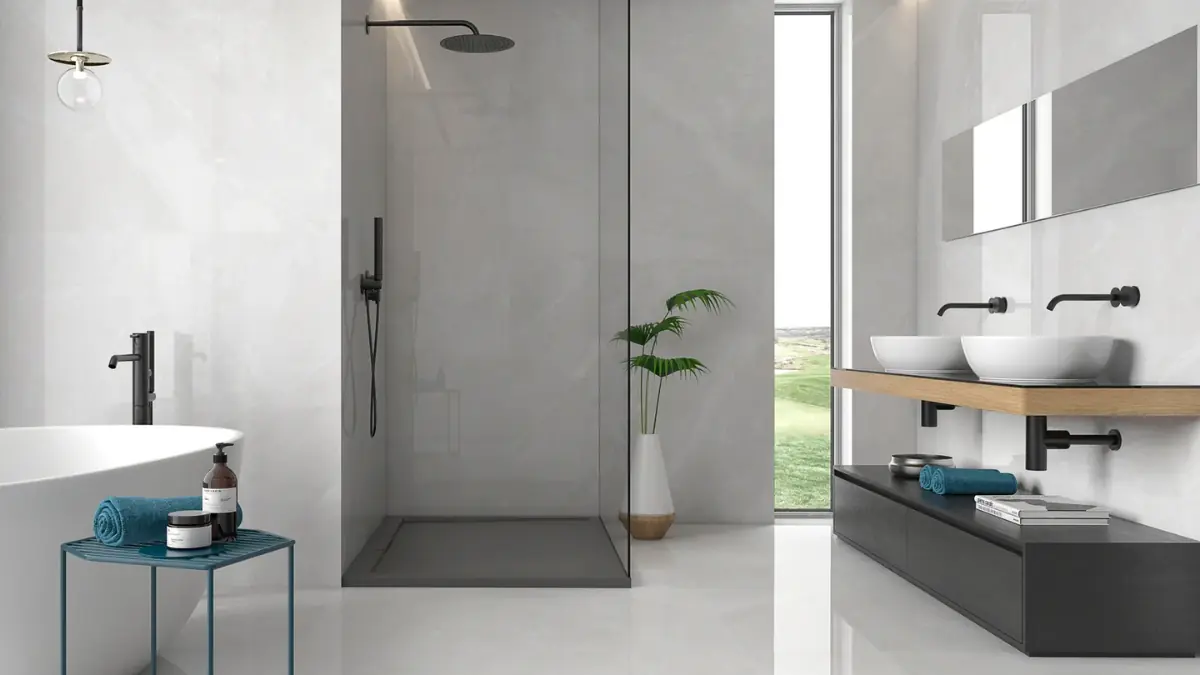
600x600mm is the familiar, versatile marble-effect tile size and works well in compact bathrooms, but for a genuinely luxurious, hotel-style finish our designers usually recommend going larger: 600×1200 is our most popular choice for bathrooms, and 1200×1200 suits larger bathrooms, ground-floor areas and open-plan spaces. The reason is simple: bigger tiles mean fewer grout lines, which reads as calmer, more seamless and more high-end. 600×600 still earns its place in smaller areas and tighter layouts, but if you want the seamless luxury look, large format is the size to choose. This guide compares 600×600 against 600×1200 and 1200×1200, and explains how to lay marble-effect tiles for a premium finish.
Tile size changes the feel of a room as much as colour does, sometimes more. The same marble-effect design looks completely different as a 600×600 square, a 600×1200 plank-style tile, or a vast 1200×1200 format. So before you fall in love with a particular tile, it is worth understanding why size matters so much, and which format will give you the look you actually want.
The quick answer: which size should you choose?
Here is how we guide clients at our Watford showroom:
- 600×1200 for most bathrooms. This is our most-recommended size for bathroom walls and floors. It gives the seamless, large-format luxury look while still being practical to install around bathroom fixtures.
- 1200×1200 for larger bathrooms, ground-floor areas and open-plan spaces. When the space can carry it, this large square format delivers the fewest grout lines and the most expansive, hotel-style finish.
- 600×600 for compact areas, cloakrooms, or tighter budgets. Still a perfectly good, versatile size, and easier to handle, but it has more grout lines than large format, so it reads as a little less seamless.
The principle behind all of this is grout lines: the fewer grout lines, the more luxurious and seamless the result. That is why, for a premium finish, we steer most clients towards 600×1200 and 1200×1200 rather than 600×600.
Why 600×600 is still a popular tile format
600×600 (sometimes written 60x60cm) is the size many people start with, and it is far from a bad choice:
- Balanced proportions. Substantial enough to read as contemporary, but not so large that it becomes awkward to handle in a small room.
- Fewer grout lines than small tiles. Compared with 300×300, metro or mosaic, a 600×600 layout has noticeably fewer joints.
- Floor-and-wall flexibility. It works on both, so you can run one tile throughout a compact room.
- Easier and cheaper to install than large format, which can keep fitting costs down on a smaller project.
So 600×600 is a sensible, versatile size, especially for compact spaces. But once you have seen 600×1200 and 1200×1200 in person, most people choose to size up for the bathroom, because the reduction in grout lines makes a visible difference to how luxurious the finished room feels.
Which marble-effect size for which space
Here is how the three main sizes compare, and where we recommend each:
| Space | Our recommended size | Why |
|---|---|---|
| Most bathrooms | 600×1200 | Seamless large-format look, practical around fixtures |
| Larger bathrooms | 1200×1200 | Fewest grout lines, full hotel-style luxury |
| Ground-floor & open-plan | 1200×1200 | Expansive, connected, high-end finish |
| Kitchen floors | 600×1200 or 1200×1200 | Refined, durable, minimal joints |
| Compact ensuites & cloakrooms | 600×600 or 600×1200 | Easy to fit neatly; 600×1200 still preferred for the look |
| Tighter budgets | 600×600 | Lower cost to buy and install, still elegant |
In a luxury bathroom in particular, large-format marble-effect tiles (600×1200 and 1200×1200) let you wrap floor and walls in one elegant material with very few grout lines, which is exactly what creates that seamless “hotel bathroom” look. 600×600 achieves a similar effect with more visible joints, so we tend to reserve it for compact spaces or where budget is the priority.
Why we recommend large format for bathrooms
The single biggest reason to size up is grout lines. Every joint between tiles is a visual interruption, and a place that can collect grime and look tired over time. Large-format tiles such as 600×1200 and 1200×1200 dramatically reduce the number of joints, which delivers three things clients consistently want:
- A calmer, more seamless, more expensive-looking finish. Fewer lines reads as luxury.
- Less grout to clean and maintain. Practical as well as beautiful.
- A sense of space. Large tiles make a room feel bigger and more considered, not smaller, contrary to the old myth that small rooms need small tiles.
This is why 600×1200 has become our most-recommended bathroom size, and why we suggest 1200×1200 wherever the space can carry it. The marble veining also has more room to read across a larger tile, which looks closer to a single slab of natural marble.
When 600×600 is still the right call
600×600 is not wrong, it is simply a different priority. Choose it when the area is genuinely compact (a small cloakroom), when budget is the deciding factor, or when an easier, lower-cost installation matters more than achieving the absolute fewest grout lines. It remains a versatile, elegant size, just not the one we reach for first when the goal is maximum luxury.
How to lay 600×600 marble-effect tiles for a luxury finish
The tile is only half the story — how it’s laid determines whether the finished room looks premium or builder-standard. Our designers obsess over these details.
Grout: the single biggest factor
Use a thin grout line (around 2–3mm) in a colour matched closely to the tile, never bright white on a soft grey or cream marble. This one choice does more than almost anything else to make a tiled surface look seamless and expensive. Wide, contrasting grout lines instantly cheapen a luxury tile.
Rectified edges
Specify rectified tiles — these are precision-cut to exact dimensions with crisp, square edges, allowing the tightest possible grout lines and the most seamless look. Non-rectified tiles need wider joints. For a marble-effect luxury finish, rectified is worth it.
Layout
- Straight stack (grid): clean, modern, lets the marble veining read clearly. The most popular choice for contemporary luxury.
- Brick bond (offset): softer, more traditional, and helpful for disguising any slight size variance, though large-format tiles should be offset by no more than a third to avoid lippage.
- Continuous floor-to-wall: running the same tile up the walls and across the floor for a cohesive, spacious effect.
Veining and “dry laying”
Premium marble-effect ranges have multiple unique faces so the pattern doesn’t obviously repeat. A good fitter will dry-lay the tiles first, arranging them before fixing, to avoid placing two near-identical faces side by side, which would betray the tile as a print. This small step makes a big difference to realism.
How to tell a quality marble-effect tile from a cheap one
Not all 600×600 marble-effect tiles are equal, and the differences are invisible in a photo but obvious in person. Here’s what separates a luxury tile from a budget imitation:
- Number of unique faces. Cheap tiles repeat the same two or three prints, so the pattern visibly tiles across a floor. Premium ranges have many faces for a natural, non-repeating look.
- Depth and realism of veining. Better tiles have nuanced, layered veining with subtle colour variation, closer to real marble. Cheap ones look flat and obviously printed.
- Edge precision (rectification). Quality tiles are precisely cut for tight joints.
- Surface finish. Premium tiles have a convincing, even finish, whether matt, polished or honed, without the slightly plasticky sheen of cheap gloss.
- Through-body and thickness. Better porcelain is dense and substantial, which contributes to durability.
This is exactly the kind of difference that a showroom visit reveals instantly and a website photo conceals — one of the main reasons we encourage clients to see tiles in person.
Colours and finishes in 600×600 marble effect
600×600 marble-effect tiles come in a wide palette and several finishes, each creating a different mood:
- White / Calacatta / Carrara effect: timeless, bright, classic luxury.
- Grey marble effect: versatile, modern and forgiving; pairs with almost any fittings.
- Black marble effect: dramatic and glamorous, best as a feature or in larger spaces.
- Green marble effect: one of 2026’s most-wanted looks, rich and jewel-like.
- Beige / cream marble effect: warm, soft and inviting.
On finish: matt is practical and contemporary (and grippier underfoot), polished is glamorous and reflective (best on walls or low-traffic floors), and honed/satin sits elegantly between the two.
How much do 600×600 marble-effect tiles cost?
Price depends heavily on quality. Basic marble-effect tiles are inexpensive, but they look it — flat veining, obvious repeats, wider joints. Premium 600×600 marble-effect porcelain sits in the mid-to-upper tile bracket, and the difference in the finished room is significant: realistic veining, rectified edges, a luxurious surface and the durability to last for many years without retiling.
Because 600×600 is efficient to install relative to large slabs, your overall project cost (tile plus labour) is often more favourable than going to full slabs, while still delivering a beautifully seamless look. For a luxury finish at sensible value, 600×600 premium porcelain is hard to beat. Our team can provide accurate, range-specific pricing for your project.
Design styles that suit 600×600 marble effect
One of the strengths of 600×600 marble-effect porcelain is how well it adapts to different interior styles. The same format reads very differently depending on the colour, finish and surrounding scheme:
- Contemporary minimalist. Large grey or white marble-effect tiles in a matt finish, straight-stacked with tonal grout, create the calm, pared-back luxury of a modern home. Pair with handleless units and matt black or brushed steel fittings.
- Classic / timeless. Calacatta or Carrara-effect tiles in a honed or polished finish bring the elegance of traditional marble, suiting period homes and more decorative schemes. Brushed brass or chrome fittings complete the look.
- Hotel luxury. Wrapping a bathroom floor-to-wall in one marble-effect tile delivers the seamless, five-star feel of a luxury hotel — 600×600 makes this achievable without the cost of slabs.
- Warm contemporary. Beige and cream marble-effect tones soften a modern scheme, working beautifully with wood-effect tiles and natural textures for a biophilic, inviting feel.
- Bold and dramatic. Black or green marble-effect tiles, used as a feature or across a powder room, make a confident statement, best balanced with calmer surfaces elsewhere.
Where to use 600×600 marble effect, room by room
- Bathrooms. The most popular use. Run it floor-to-wall for a cohesive, expansive look, with a slip-resistant (matt) finish on the floor and a polished version on the walls if you want a little sheen. The format fits neatly around fixtures in compact ensuites yet still feels luxurious.
- Kitchens. As a durable, refined floor that handles heavy traffic and spills, and wipes clean easily. Marble-effect porcelain also works as a worktop or splashback in larger formats, so you can echo the floor on other surfaces.
- Hallways and entrances. A marble-effect 600×600 floor makes a hard-wearing, low-grout first impression — practical for a busy threshold, luxurious to arrive home to.
- Living and open-plan spaces. Running 600×600 continuously through open-plan areas visually connects the spaces and makes them feel larger, especially with underfloor heating beneath for comfort underfoot.
Caring for marble-effect porcelain tiles
A major advantage of marble-effect porcelain over real marble is how little care it needs. Unlike natural marble, it doesn’t need sealing, doesn’t etch from acidic products, and resists staining. To keep it looking its best:
- Clean with pH-neutral products and avoid harsh abrasives that could dull a polished finish.
- Wipe up spills promptly on polished finishes to avoid water spotting (more for appearance than damage).
- Keep grout clean. Matched-tone grout hides marks better and ages more gracefully than white.
- In hard-water areas (much of Hertfordshire), wipe down wet walls to limit limescale on polished surfaces.
That’s essentially it — no annual resealing, no special stone care. The look of marble, the maintenance of porcelain.
600×600 vs other popular formats at a glance
| Format | Look | Grout lines | Best for |
|---|---|---|---|
| 300×600 | Classic, flexible | Moderate | Walls, smaller areas |
| 600×600 | Balanced, refined | Few | Compact rooms, tighter budgets |
| 600×1200 | Sleek, seamless | Very few | Most bathrooms (our top pick) |
| 1200×1200 | Expansive, luxe | Minimal | Larger bathrooms, open-plan, ground floor |
The takeaway: for a luxury finish, larger is better. We recommend 600×1200 for most bathrooms and 1200×1200 for larger or open-plan spaces, reserving 600×600 for compact areas or tighter budgets.
Why marble-effect porcelain beats real marble (for most homes)
It’s worth being clear about why marble-effect porcelain has become the choice of so many designers over real marble, especially in 600×600 format. Natural marble is undeniably beautiful, but it’s porous, soft and high-maintenance: it stains, etches from acids (including everyday products like lemon, wine and some cleaners), scratches, and needs sealing and careful lifelong care. In a bathroom or kitchen, that’s a real commitment.
Marble-effect porcelain captures the look, the veining, the colour, the elegance, in a material that is virtually non-porous, hard-wearing, stain-resistant and needs no sealing. You get the timeless beauty of marble with the durability and low maintenance of porcelain, at a more accessible price. For the vast majority of homes, that’s a better deal: the look you love, without the worry. Natural marble still has its place in dry, low-use, budget-no-object settings, but for real, used spaces, premium marble-effect porcelain is usually the smarter luxury.
Choosing the right marble-effect look for your home
With so many marble-effect options in 600×600, a little guidance helps narrow the field. Think about three things: the base colour, the veining intensity, and the finish.
The base colour sets the mood and should harmonise with your fittings and the room’s light. Whites and creams brighten and suit most schemes; greys are the great all-rounder, modern and forgiving; warmer beiges add cosiness; bold greens and blacks make statements. If your bathroom has limited natural light, lean toward lighter tones to keep it feeling open.
The veining intensity determines how much drama the tile brings. Subtle, fine veining (Carrara-style) is calm and versatile, easy to live with and timeless. Bold, dramatic veining (Calacatta or statement marbles) makes more of a feature and works best where it can be seen as a hero, balanced by plainer surfaces. In a small room, busier veining across every surface can feel overwhelming, so consider using a dramatic tile as a feature and a calmer one elsewhere.
The finish is the final lever. Matt is contemporary, practical and safer underfoot. Polished is glamorous and reflective, bouncing light around a room, but best kept to walls or low-traffic floors. Honed or satin sits elegantly between the two. Seeing these finishes side by side, under realistic light, is the surest way to choose — what looks subtle on a screen can look very different in a real bathroom.
Bring these three decisions together and you’ll have a marble-effect scheme that suits your home rather than a generic choice, and our designers are always happy to help you weigh them up.
Common questions about installation and planning
- How many tiles will I need? Calculate your area in square metres and add roughly 10% for cuts and wastage (more for complex layouts or diagonal patterns). Always order spares from the same batch.
- Can 600×600 go over underfloor heating? Yes, porcelain is an excellent conductor and a great partner for underfloor heating, which makes a marble-effect floor feel warm and luxurious underfoot.
- What thickness do I need? Standard wall and floor tiles suit most interiors; heavier-duty or thicker formats exist for specific applications (such as outdoors). Your specifier will advise.
- Do I need a professional fitter? For a luxury finish — tight grout lines, dry-laid veining, level large-format tiles — a skilled fitter makes a significant difference. 600×600 is more forgiving than slabs but still rewards expertise.
Frequently asked questions
Is 600×600 a good size for bathroom tiles?
600×600 is a versatile, perfectly good size, especially for compact bathrooms and tighter budgets. For a more seamless, luxurious finish, though, we usually recommend sizing up to 600×1200 for most bathrooms, or 1200×1200 for larger spaces, because fewer grout lines look more high-end.
Should I choose 600×600 or 600×1200 marble effect tiles?
For most bathrooms we recommend 600×1200. It gives a more seamless, large-format luxury look with fewer grout lines, while still being practical to install around fixtures. Choose 600×600 for compact spaces, cloakrooms, or where budget is the priority.
What is the best tile size for a large bathroom?
For larger bathrooms, ground-floor areas and open-plan spaces we recommend 1200×1200 marble-effect porcelain. The large square format gives the fewest grout lines and the most expansive, hotel-style finish.
Are large tiles or small tiles better for a small bathroom?
Larger tiles generally make a small bathroom feel bigger by reducing grout lines. The old “small room needs small tiles” rule is outdated. Even in a compact bathroom, 600×1200 often looks more spacious and more premium than 600×600.
What grout colour should I use with marble effect tiles?
A colour matched closely to the tile (not bright white) gives the most seamless, premium finish. Wide or contrasting grout lines make luxury tiles look cheaper.
Can you use 600×600 tiles on walls?
Yes, and running the same 600×600 tile on both floor and walls is a designer technique for a cohesive, spacious feel. Just choose a slip-resistant finish for any floor that gets wet.
What’s the difference between cheap and expensive marble effect tiles?
Quality tiles have more unique faces (so the pattern doesn’t repeat), more realistic and layered veining, rectified precision edges and a better surface finish. These differences are obvious in person but hard to see in photos.
Should I choose matt or polished marble effect tiles?
Matt is practical, contemporary and grippier underfoot (good for floors); polished is glamorous and reflective (best on walls or low-traffic floors). Honed/satin is an elegant middle ground.
What is a rectified tile?
A rectified tile is precision-cut to exact dimensions with crisp, square edges, allowing very tight grout lines and a more seamless finish. It’s worth specifying for a luxury marble-effect look.
How many 600×600 tiles are in a square metre?
There are approximately 2.78 tiles per square metre (each 600×600 tile covers 0.36m²). Always add around 10% extra for cuts and wastage, and order spares from the same batch.
Can I use 600×600 marble effect tiles outdoors?
Standard 600×600 tiles are designed for interiors. For outdoor use, choose a dedicated outdoor porcelain (often 20mm thick) with appropriate slip resistance — some ranges offer matching indoor and outdoor versions for a seamless indoor-outdoor flow.
Do marble effect porcelain tiles need sealing?
No — unlike natural marble, marble-effect porcelain is virtually non-porous and never needs sealing. This is one of its biggest advantages over real marble for bathrooms and kitchens.
Will the pattern repeat on my floor?
On budget tiles with few faces, yes, the repeat becomes visible. On premium ranges with many unique faces, a good fitter dry-lays the tiles to avoid placing similar faces together, so the floor looks naturally varied like real marble.
See 600×600 marble effect alongside larger formats in Watford
The realism of a marble-effect tile, and the difference between formats, only truly shows in person. Visit our Watford showroom to compare 600×600 against 600×1200 and full slabs side by side, see how the veining and edge quality differ across ranges, and get honest advice on the right size for your space.