
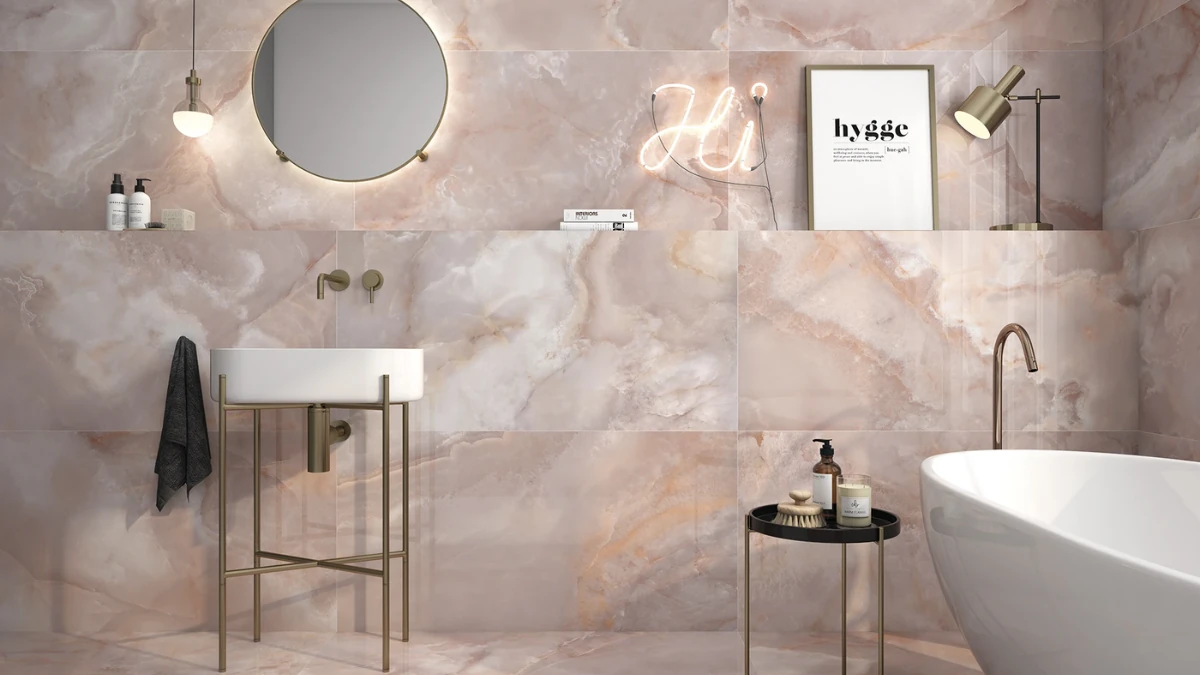
Yes, onyx tiles are an excellent choice for luxury bathrooms when you choose onyx-effect porcelain rather than natural onyx, because porcelain reproduces onyx’s dramatic, translucent, jewel-like glow while offering near-zero water absorption, strong scratch and stain resistance and no sealing, whereas natural onyx is porous, soft and high-maintenance and poorly suited to wet areas.
For any bathroom or wet room we therefore recommend onyx-effect porcelain: you keep the showstopping look, including the backlit effect on premium ranges, without the constant risk of water damage, etching and staining. Used as a single feature — a backlit wall, a vanity surround, a statement shower panel — onyx transforms a bathroom from ordinary to unforgettable.
That is the honest, direct answer. But “should you use onyx in your bathroom?” deserves a proper conversation, because onyx is one of the few materials that can either make a bathroom look spectacular or, used carelessly, look overwhelming and impractical. In this guide, our design team at Design Di Lusso shares exactly how we use onyx-effect tiles in luxury bathrooms, where they shine, where to hold back, how much they cost, and the practical realities most articles gloss over.
What is onyx, and why is it so coveted?
Onyx is a calcite-based natural stone, prized for thousands of years for one extraordinary property: translucency. Unlike marble or granite, light can pass through onyx. When a slab is backlit, it appears to glow from within, revealing swirling bands of colour in honey, amber, green, white and pink that look almost like frozen liquid. No other natural surface in interior design behaves quite like it.
This is why onyx has always been a material of palaces, luxury hotels and high-end spas. It signals rarity and craft. In a bathroom, a space that is increasingly designed as a private sanctuary rather than a purely functional room, that sense of drama and indulgence is exactly what many homeowners are now looking for.
But onyx’s beauty comes with a catch, and understanding that catch is the single most important thing in deciding whether it belongs in your bathroom.
The crucial decision: natural onyx vs onyx-effect porcelain
Here is where most people go wrong, and where good advice genuinely matters. There are two completely different products both sold under the word “onyx,” and confusing them leads to expensive mistakes.
Natural onyx is the real stone. It is breathtaking, but it is also:
- Highly porous. It absorbs water and stains readily, which is a serious problem in a wet, frequently used bathroom.
- Soft and brittle. Onyx scratches, chips and etches more easily than most stones. Acidic products, including some cleaning sprays, toothpaste or perfume, can dull and mark it.
- Maintenance-heavy. It requires regular professional sealing, and even then it needs careful, gentle care for life.
- Very expensive, both to buy and, crucially, to live with.
Onyx-effect porcelain is a high-quality porcelain tile printed and glazed to replicate onyx’s veining and, on premium ranges, its translucency. It offers:
- Near-zero porosity. It is virtually waterproof, which makes it ideal for bathrooms and wet rooms.
- Excellent durability. It is hard-wearing, scratch-resistant and stain-resistant.
- Minimal maintenance. There is no sealing to do, just normal cleaning.
- Accessible luxury, at a fraction of the cost of natural onyx, with dramatically lower lifetime upkeep.
| Factor | Natural Onyx | Onyx-Effect Porcelain |
|---|---|---|
| Water resistance | Poor — porous, needs sealing | Excellent — virtually non-porous |
| Staining | Stains and etches easily | Highly stain-resistant |
| Durability | Soft, scratches and chips | Hard-wearing |
| Maintenance | High (regular resealing) | Minimal (normal cleaning) |
| Backlit translucency | Yes — the real glow | Yes — on premium ranges |
| Cost to buy | Very high | Accessible premium |
| Cost to live with | High (ongoing care) | Low |
| Best use | Display, dry feature areas | Bathrooms, wet rooms, anywhere |
Our clear recommendation: for any bathroom, and especially for showers and wet rooms, choose onyx-effect porcelain. You keep the showstopping look, including the backlit glow on the right ranges, without the constant anxiety about water damage, staining and scratching.
Where onyx tiles work brilliantly in a bathroom
Onyx is a hero material, not a background one. The secret to using it well is restraint: let it be the star of one element, supported by calmer tiles around it.
1. A backlit feature wall
This is onyx at its most spectacular. A wall of onyx-effect porcelain with LED lighting behind or grazing across it becomes the focal point of the entire room — behind a freestanding bath, as a headboard-style panel, or as a full shower wall. The glow is genuinely jaw-dropping and photographs beautifully.
2. A statement shower
A single onyx-effect wall in a walk-in shower turns a daily routine into a sensory experience. Pair it with large-format porcelain on the remaining walls so the onyx reads as deliberate luxury rather than visual chaos.
3. Vanity surrounds and splashbacks
A band of onyx behind the basins, or framing a vanity, introduces richness at eye level without committing the whole room. It’s a brilliant “first taste of luxury” the moment you walk in.
4. Niches and recesses
Lining a shower niche or a recessed shelf with onyx-effect tile is the classic “small spend, big impact” move. The eye is drawn to the jewel-box detail.
Where to be cautious with onyx
- Don’t tile the entire room in onyx. Onyx’s power comes from contrast and restraint. A full room of busy, glowing veining quickly tips from luxurious to overwhelming. Use it on one feature, balanced by quieter marble-effect, stone-effect or plain tiles.
- Mind your lighting. Onyx’s veining shifts character dramatically under warm versus cool light. Always view samples under lighting similar to what you’ll have at home.
- Busy veining in a small room can feel claustrophobic. In a compact ensuite, a smaller onyx feature often works better than a whole wall.
- Coordinate the colour story. Onyx’s bold tones (especially green and pink) need to be deliberately tied to your fittings, brassware and other tiles.
Onyx colours and what they bring
- White / cream onyx. The most versatile and timeless; elegant, soft, luminous. Works in almost any scheme.
- Green onyx. Currently one of the most sought-after looks of 2026; rich, jewel-like and dramatic, especially with brushed brass or gold fittings.
- Honey / amber onyx. Warm and inviting, perfect for a cosy, spa-like feel.
- Pink onyx. Soft, romantic and distinctive; a favourite for boutique-style bathrooms and powder rooms.
- Black / dark onyx. Intensely glamorous and moody; best in larger or well-lit spaces.
How much do onyx tiles cost?
Onyx-effect porcelain sits firmly in the premium tile bracket, yet costs a fraction of natural onyx — and a tiny fraction once you account for lifetime maintenance. Because onyx is typically used as a feature rather than across an entire room, the overall cost impact on a project is usually modest relative to the visual return. Our design team can give you accurate, project-specific pricing once we understand the area and range you’re considering.
Designing with onyx: a quick best-practice checklist
- Use it as one feature: balanced by calmer tiles.
- Choose onyx-effect porcelain for any wet area.
- Plan the lighting first: onyx and lighting are inseparable, especially for backlit effects.
- Sample in situ: under your real light, before committing.
- Coordinate brassware and fittings to the onyx’s tone (brass/gold with green and honey; chrome or black with white and dark onyx).
- Specify rectified, large-format tiles for the most seamless feature wall.
- Keep grout lines thin and tonally matched for a luxury finish.
How to light onyx properly
Backlighting is the showstopper. By placing an LED panel behind a translucent onyx-effect tile, you make the stone appear to glow from within, dramatically revealing its veining. It requires planning at the construction stage — you need the depth, the electrical provision and the right translucent range — so decide early.
Grazing light is the subtler alternative. Positioning a light source close to and across the surface catches the texture and veining without full backlighting. It’s easier to achieve and still delivers real drama.
Ambient and task lighting need to complement, not fight, the feature. Warm light (around 2700–3000K) flatters honey, amber, pink and green onyx. Cooler light suits white and dark onyx. Avoid harsh, flat overhead lighting alone — layered lighting, with the onyx feature as the focal glow, is the goal.
Onyx vs marble vs other statement materials
| Material (effect porcelain) | Character | Drama level | Best role |
|---|---|---|---|
| Onyx | Translucent, glowing, jewel-like | Very high (especially backlit) | Single dramatic feature |
| Marble | Classic, elegant, veined | Medium–high | Whole room or feature |
| Travertine / stone | Warm, natural, organic | Low–medium | Calm, spa-like base |
| Terrazzo | Playful, speckled, contemporary | Medium | Accent or floor |
Marble-effect is the more versatile, do-anything luxury surface. Onyx is the specialist: more dramatic, but best reserved for one hero moment. Many of our most successful bathrooms combine the two — calm marble-effect across the room, with a single backlit onyx feature wall as the jewel.
Real-world ways our clients use onyx
- The bath alcove. A backlit onyx-effect panel behind a freestanding bath turns the bath into a centrepiece. This is the single most popular luxury onyx application.
- The hotel-style shower. One onyx-effect wall in a walk-in shower, with the remaining walls in calm large-format porcelain, brings five-star drama to a daily routine.
- The powder room. A small WC or cloakroom is the perfect place to be bold — pink and green onyx shine here.
- The vanity feature. A band of onyx behind the basins or framing the mirror introduces richness at exactly the height people notice it.
- The ensuite accent. In a compact ensuite, a slim onyx feature — a niche or a single narrow panel — adds luxury without overwhelming.
A buyer’s checklist before you commit to onyx
- Effect-porcelain or natural? For a bathroom, almost always effect-porcelain.
- Is the range translucent enough to backlight? Test a sample with a light behind it before buying.
- Where is the single feature? Decide the one hero placement.
- What’s the supporting palette? Choose the calm tiles, brassware and fittings that will frame the onyx.
- Is the lighting designed in? Backlighting must be planned at construction stage.
- Have you seen it in person, under realistic light? Non-negotiable.
- Does the colour suit the room’s mood and light? Warm tones for cosy, cool tones for contemporary.
Frequently asked questions
Are onyx tiles waterproof?
Onyx-effect porcelain tiles are virtually non-porous and highly water-resistant, making them ideal for bathrooms, showers and wet rooms. Natural onyx is porous and not recommended for wet areas without careful, repeated sealing.
Can onyx tiles be backlit?
Yes. Translucency is onyx’s signature feature, and premium onyx-effect porcelain can be backlit to create a glowing feature wall. The strength of the effect varies by range, so always check a sample with backlighting before specifying.
Are onyx tiles expensive?
Onyx-effect porcelain is a premium tile but costs far less than natural onyx, and dramatically less to maintain. Because onyx is usually used as a feature rather than throughout a room, the cost impact is often smaller than people expect for the visual impact it delivers.
What colours do onyx tiles come in?
Popular options include white and cream, green, honey/amber, pink and black/dark onyx — each with distinctive veining and a different mood, from timeless and soft to dramatic and glamorous.
Do onyx tiles scratch easily?
Natural onyx is soft and scratches relatively easily. Onyx-effect porcelain is hard-wearing and scratch-resistant — another reason it’s the better choice for a real, used bathroom.
Is onyx too bold for a small bathroom?
Not necessarily, but in a small space we recommend using onyx as a smaller feature — a niche, a slim band, or a single accent wall — rather than across large areas.
How do you clean onyx-effect tiles?
Onyx-effect porcelain needs only normal, non-abrasive cleaning — no sealing required. Natural onyx needs gentle, pH-neutral products and careful maintenance to avoid etching.
Onyx in different bathroom styles
- Contemporary luxury. Pair a backlit white or dark onyx feature with large-format matt porcelain, handleless joinery and matt black or brushed steel brassware.
- Classic and opulent. Green or honey onyx with polished marble-effect tiles and brushed brass fittings creates rich, hotel-suite opulence.
- Boutique and characterful. Pink or amber onyx in a small powder room, paired with a statement basin and warm metallics, delivers a jewel-box feel guests remember.
- Spa and natural. Even in a calm scheme, a single panel of softly veined onyx lit with grazing light adds depth without breaking the serenity.
Onyx-effect tiles and resale value
A well-executed, tasteful luxury feature generally adds to a bathroom’s appeal — high-end bathrooms are a recognised selling point. The key word is tasteful. A single, beautifully lit onyx feature wall in an otherwise elegant bathroom reads as a premium, considered upgrade. Restraint protects both the look and the value.
Why see onyx before you buy
Onyx is the single worst tile to judge from a photograph. Its defining qualities — translucency, depth, the way light moves through and across it — simply don’t transmit through a screen. Seeing samples in a showroom, ideally with a light source, is the difference between a confident decision and an expensive guess.
Visit our Watford showroom
Onyx is a material you genuinely have to see. Visit our 7,000 sq ft showroom in Watford to experience our onyx-effect collections under proper lighting, see backlit samples, and talk through your bathroom design with our award-winning team.